The knuckle-bone floor of Alkmaar: medieval trend or bad taste?

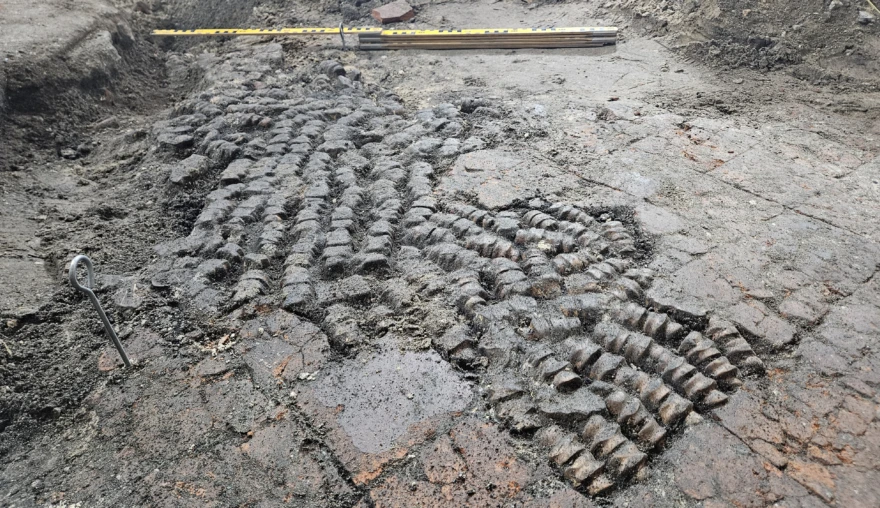
A knuckle-bone floor wasn't the first thing I expected to study when an archaeozoologist approached me. Discovered in 2024, this 15th-century floor is located in the Achterdam, in one of the oldest streets in Alkmaar.
For centuries, it housed all types of artisanal activities, which is reflected by modern-day workshops that focus on producing goods using traditional technology (which, as someone who is interested in ancient technology, makes my heart beat faster). Inside one of the street's historical buildings, currently home to a health support centre for sex workers, the remnants of a bone floor are now displayed in their original position beneath a protective glass floor. The bone floor construction consists of countless cattle bones that were sawn in half and placed vertically in the ground. Together, they form a geometric pattern that, from a modern perspective, seems randomly placed between the tiles. The question raised was: what was the function of this low-budget, somewhat macabre part of the floor?
Archaeologists from the municipality of Alkmaar and the archaeozoologist were faced with a mystery. Why would the occupants of the Achterdam put so much effort into preparing and placing these bones just to fill a gap within a cheap tile floor? Did it function as an indoor floor to walk on, or was it part of a subfloor construction consisting of multiple layers with a wooden floor on top?
The pedestrian experiment
So my journey as a pedestrian on my own custom-built knuckle-bone floor began. Since both building a knuckle-bone floor and conducting use-wear analysis take a lot of time, I decided to build a small-scale floor using a grand total of just four pieces of cattle bone. These were put vertically into the underlying ground (sand) and placed between tiles that had been lying around for some unclear reason. To be honest, the beginning was a struggle, since the construction collapsed several times, but finally I got the hang of it, using wooden sticks to secure the tiles in place. And then came the shoe problems. For a long time, medieval leather shoes were quite flexible, featuring a single-layered sole. To protect their feet from painful or rough terrain, people wore overshoes (often with thick wooden soles) over their leather footwear. Paved streets became increasingly common during the 15th century and shoe soles with multiple layers of thick leather became more and more the norm (Volken 2022, 69-70). So the question of what to wear became top of mind.
Studying a selection of four cattle bones from the historical bone floor using a stereomicroscope and a metallurgical microscope in Leiden was about to provide more clarity. However, cattle metapodia (term for specific long bones) sawn in half are pretty large objects to study under a microscope. As a solution, combining a free-arm microscope with a platform and supportive tower built from Duplo blocks did the trick to hold the bones in place (and yes, some use-wear analysts actually use Duplo figures as a supportive stand to firmly secure an artefact in place, meaning they come in handy quite literally). Due to construction activities in the vicinity of the laboratory, the microscope was rather shaky, especially during active pile driving. Fortunately, between these pile driving sessions, it was possible to do the analysis and make some microscopic pictures.
Through the microscope, the surface of the archaeological bones of the Achterdam is magnified up to 200 times, revealing a stunning landscape. A trained eye can easily spot the areas where use-wear traces are present. In this case, the wear traces consisted of a polished surface that was distinctly greasy with clusters of well-developed, broad striations in different directions (see fig. 1, left). Since contact with wood typically creates a bright polish, this rules out any use-wear created by friction with a wooden top floor. The same applies to overshoes with a wooden sole, leaving open the option of (over)shoes with leather soles. Although most modern shoes have synthetic soles, I managed to hunt down a pair of riding shoes with a stiff leather sole to see if I could replicate these traces on my own knuckle-bone floor.
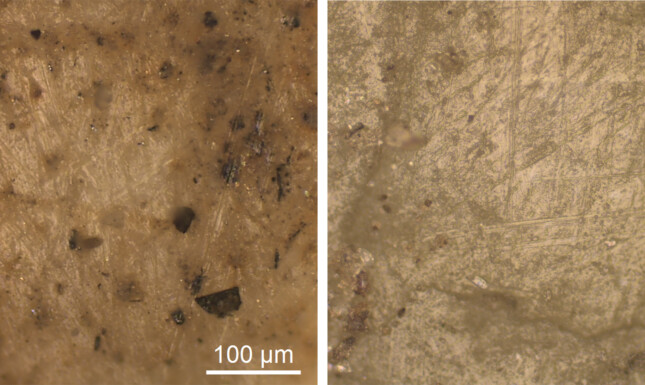
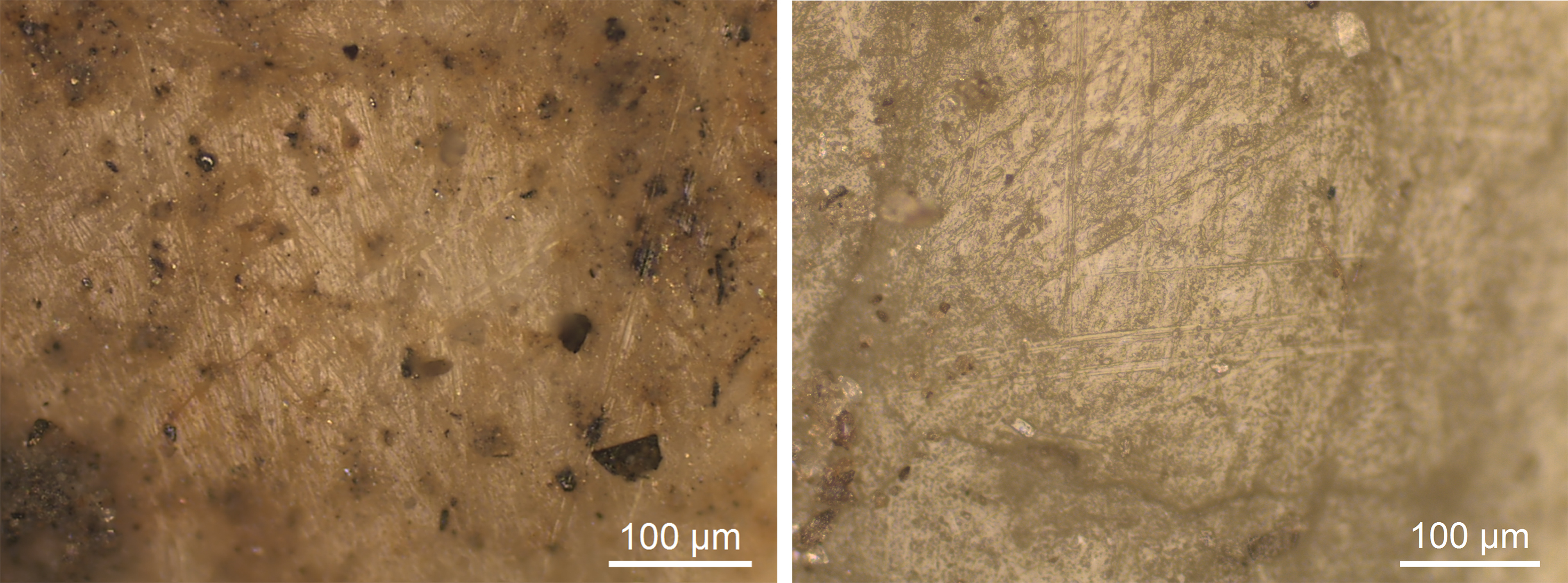
As always, the execution of the experiment itself was rather repetitive. After pacing back and forth endlessly on my own custom-built knuckle-bone floor, it was time to head back to the shaky free-arm microscope and the Duplo tower (which, of course, I had to rebuild yet again) to compare the traces of the experimental knuckle-bone floor with the archaeological sample. The big question was, was it worth all the fuss? The answer is yes, since it answered the question if it was walked on. The traces were strikingly similar (compare fig. 1, left, with right), with the major difference being that on the archaeological sample the surface was more rounded by use. This was probably due to far more intensive use compared to my half hour of endlessly walking back and forth on a tiny floor. Thus, the occupants of the Achterdam no. 7 in Alkmaar walked with (over)shoes with a leather sole on the knuckle bone floor. The intriguing question remains: why would one want such a floor?
More than a floor?
Several other traces on the knuckle-bone floor might shine some light on this given. The knuckle-bones were also covered in traces of bone-to-bone contact and traces of contact with metal, suggesting a possible function as a floor that was used to process carcasses. A floor made from metacarpal bones would be excellent for drainage and some of these floors are associated with finds that can be connected to the processing of carcasses and tanning activities (Beckley & Radford 2011, 19, 35, 65). There is, however, a big BUT, since the latter traces are prone to multiple interpretations and could be derived from archaeological practices. The bones were kept and transported together in one bag (bone-to-bone contact) and the metal traces could reflect archaeological excavation practices.
Alternatively, we have to look further away, beyond the front door of the historical building in the Achterdam. Surprisingly, the knuckle-bone floor of Alkmaar is not an isolated phenomenon. Similar floors have been discovered in Hoorn, Edam, and Enkhuizen, suggesting they were actually a 'thing' in the province of North Holland and the historical region of West Friesland in the 15th and 16th centuries. These floors were often produced from cattle bones, some were placed between tiles and some were placed outside, rather than inside a building like in the Achterdam (e.g. Schrickx 2018, 20–22; Walle-Van der Woude 1999, 348). Later on, this practice either revived or developed independently in Oxfordshire (England) between the 17th and 18th centuries. There, it was likely born out of necessity, as a direct reaction to rapid population growth and booming meat consumption. In other words, the discarded waste of this meat consumption became a cheap, locally available building material (see Moore 2006, 395-396). These floors are thus a showcase of human resilience and cultural adaptation to shifting circumstances. However, not every knuckle-bone floor was born out of a sober lifestyle. During and after the 18th century, decorative knuckle-bone floors made from the less common fallow deer bones were placed in structures such as summer houses in British estates and thus became symbols of luxury (Ward et al. 2019, 160-162; 164-167). In this case, though the underlying principle remained the same, the scarcity of the animal transformed the social value of this type of floor.
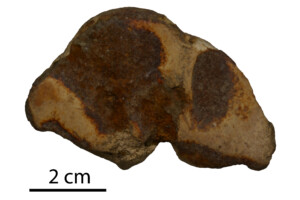
Though not widespread, the knuckle-bone floor of Alkmaar was not an isolated case when put in time and space. Putting personal taste aside, the use of knuckle-bones provided a cheap, practical solution in which waste from the food industry was recycled. Although the experiment proved that the floor was actually used for pedestrian activities, the floor's true secrets have not yet been fully unleashed. On multiple bones, a mysterious reddish-brown residue is present (see fig. 2). Perhaps one day, further analysis will reveal whether these knuckle-bones were part of an even bigger story than just a floor to walk on.
About contract archaeology
This case study is a valuable supplement to the already existing body of work in experimental archaeology. Contract archaeology can be a catalyst for research questions regarding archaeological phenomena that would otherwise not be studied academically (as we also argue in Van den Dikkenberg et al. in press). Although trampling experiments (which mimic what happens to archaeological objects when they are lost, abandoned, buried in the ground, and walked over) are done more often, no experiments had been carried out on the effects of regular pedestrian traffic on different types of floors.
Further reading
Beckley, R., & Radford, D. (2011). Oxford archaeological resource assessment 2011: Post medieval (1540–1800). Oxford City Council.
Moore, H. (2006). Medieval buildings and land reclamation at the former Lion Brewery, St Thomas’ Street, Oxford. Oxoniensia, 71, 393–412.
Schrickx, C. P. (2018). Archeologische waarneming in en achter het pand Gerritsland 7 in Hoorn (West-Friese Archeologische Notities 32). Gemeente Hoorn.
Van den Dikkenberg, L., Houkes, R., Kromotaroeno, C., Verbaas, A., Wentink, K., Helmecke, F., Westra, A., & Van Gijn, A. (in press). Expect the unexpected: Celebrating 30 years of collaboration between academia and contract archaeology in microwear analysis. Analecta Praehistorica Leidensia. Sidestone Press.
Volken, M. (2022). Archaeological footwear II: Sandals, pattens and mules from the Roman, medieval and modern periods. Spa Uitgevers.
Walle-Van der Woude, T.Y. van de. (1999). Hoorn: Gouw 16. Archeologische Kroniek van Holland over 1998, deel I: Noord-Holland, 347–348.
Ward, C., Baker, K., Carden, R., Evans, J., Higham, T., Hoelzel, R., Lamb, A., Madgwick, R., Miller, H., Rosvold, J., Secchi, E., & Sykes, N. (2019). In view and under foot: The hidden story of fallow deer, knuckle-bone floors and British estates. Post-Medieval Archaeology, 53(2), 157–171.
Online
Erfgoed Alkmaar. Achterdam 7. Monumentenkaart Erfgoed Alkmaar. https://www.erfgoedalkmaar.nl/monumentenkaart/de-achterdam/
Erfgoed Alkmaar. (2026, 22 augustus). Meer bekend over bottenvloer dankzij specialistisch onderzoek. https://www.erfgoedalkmaar.nl/nieuws/meer-bekend-over-bottenvloer-dankzij-specialistisch-onderzoek/
Perry, S. (2021, 11 oktober). Museum of Oxford's top ten exhibitions. Oxford Mail. oxfordmail.co.uk. https://www.oxfordmail.co.uk/news/19611213.museum-oxfords-top-ten-exhibitions/