Of Donar and Mittens. The Leithon 'amulet' as nalbinding needle

According to the ‘First Law of Archaeology’, whenever archaeologists do not know what an object is, then it must be something religious. In this case, a Donar pendant may be simply a needle for nalbinding. But the story is no less exciting!
Written in collaboration with Jolijn Schalkwijk.
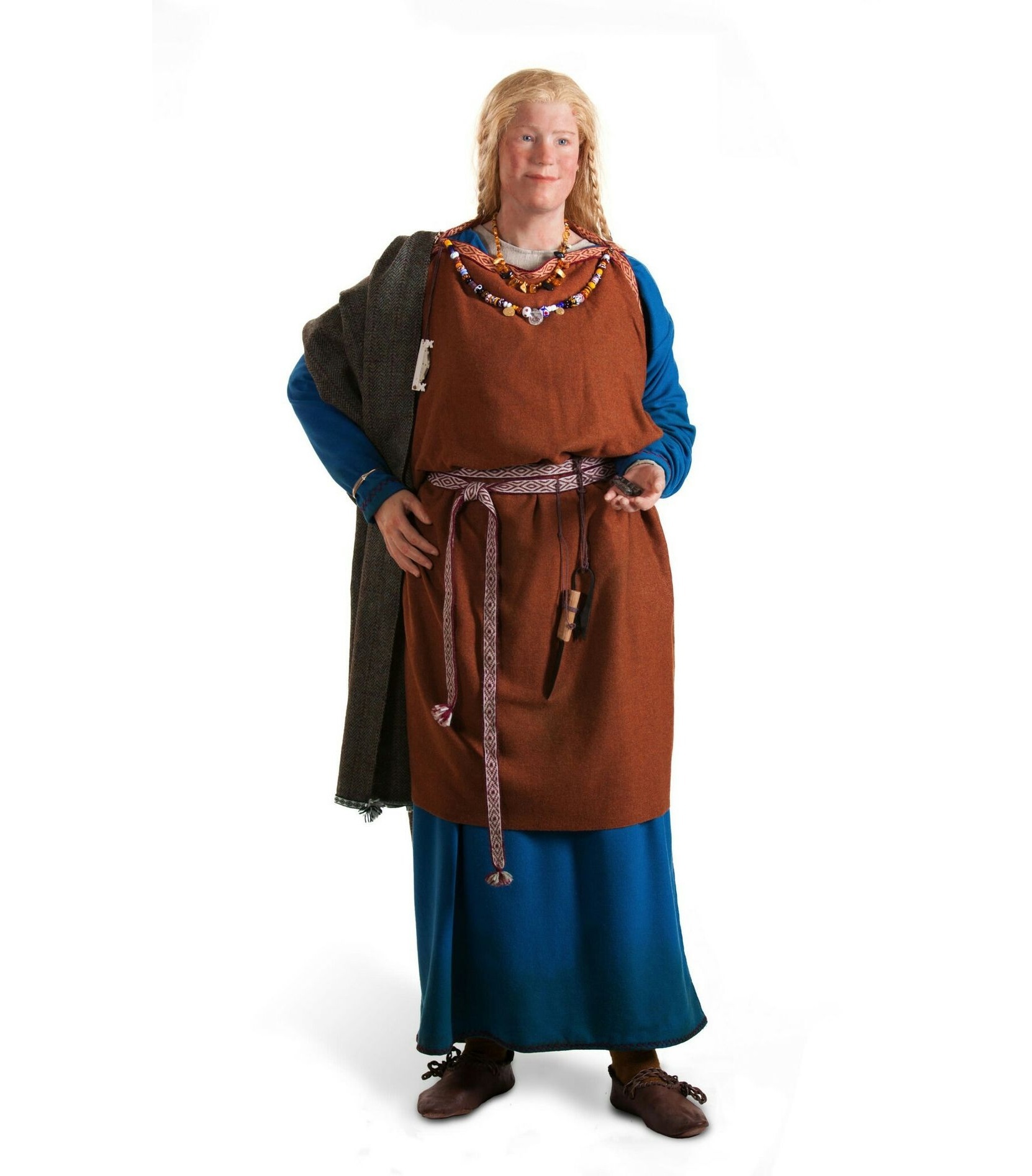
Not far from the campus of Leiden University, in the neighbouring town of Leiderdorp, archaeologists discovered an early ancestor of the modern town, dating back all the way to the late Merovingian and Carolingian periods, roughly between the seventh and ninth centuries AD. The site of Leiderdorp-Plantage, or ‘Leithon’, as it was probably called in this period, was somewhat of an ordinary rural settlement, typical for this area of the Rhine estuary. It consisted of several farmyard plots with wooden houses adjacent to a waterway, a gully or side river of the Oude Rijn. Its inhabitants made their living the way most ordinary people of the Early Middle Ages did in this area: they kept animals (mostly cows), fished, crafted, farmed and perhaps sailed the Rhine River and North Sea.

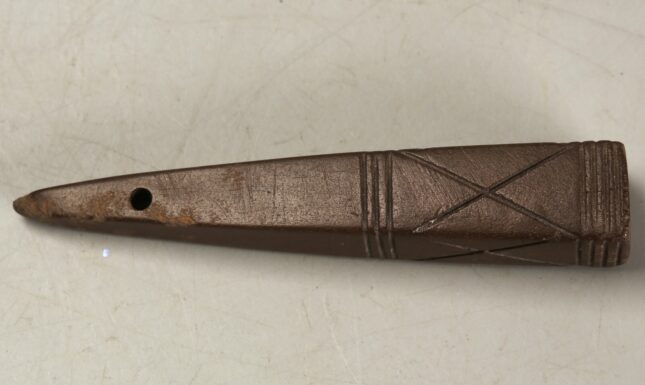
One object found by the archaeologists excavating, however, seems to be more extraordinary, the so-called ‘Donar amulet’ of Leiderdorp, so striking that it has even gained its own entry into the archaeological canon of the province of Zuid-Holland. It is a trapezoid-shaped object made of antler with a small hole, found among 200,000 other finds (!) in gully deposits, essentially the refuse of Leithon’s Early Medieval inhabitants. It is possible to thread a cord through the hole, which has led to the idea that it was some kind of pendant that could be worn as earing, necklace or tied to the belt. Because of its curious shape and decorative carvings, it could be some kind of religious object that was worn as an amulet to ward off evil.
Donar’s club
In fact, many objects like the Leiderdorp ‘amulet’ have been found throughout Early Medieval Europe, from Ukraine to northern France, dating between the fourth to seventh centuries. They have been identified as amulets, called donarknots (in Dutch), Donarskeule (in German), or ‘Donar club’. The idea was first proposed by Andreas Alföldi in 1933 and later expanded upon by Joachim Werner in 1963.
Werner’s argument goes as follows. From Roman graves dating roughly to the third century, certain club-shaped pendants have been excavated, for instance in Cologne and Bonn. One large gold pendant shaped like an octagonal club from Cologne-Nippes bears the inscription ‘DEO HER(CULI)’, ‘to the god Hercules’. Fair enough, the classical hero Heracles is known for wielding a fiercesome club. For the indigenous people of northwestern Europe, it would have been easy to associate the classical Hercules with their own warrior god Donar (the Norse Thor) of the Germanic pantheon, known to wield a hammer. By the tenth century, Thor’s hammer or Mjölnir is commonly worn as a pendant throughout the Viking world, and Werner therefore supposes that our trapezoid pendants represented an intermediate type of the Migration Age Germanic peoples. In support of his theory, Werner notes that like the Roman Hercules pendants, the Donar amulets are found commonly in women’s and children’s graves. Curiously, he connects this to both Donar and Hercules being associated with fertility, although how the lion-slaying Hercules is associated with fertility raises more questions than answers.
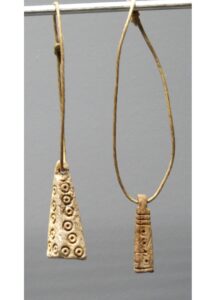
It is possible that the Early Medieval inhabitants of Holland wore amulets dedicated to Donar. The Indiculus superstitionem et paganiarum, an eighth century list of pagan practices (“superstitions”) observed in Frisia and Saxony offers some clues. It has an entry on filacteriis et ligaturis (‘amulets and bindings’) and mentions festivals for Jovi vel Mercurio, Latin names for local deities who could be interpreted as Odin and/or Wodan. The Donar clubs have been used as supporting evidence for the existence of a Donar-cult in Early Medieval Holland by Rob van Eerden and Johan Nicolay (2024). Similar pendants have been found in a ‘sacrificial pool’ in Beverwijk-Heemskerk, Valkenburg, a cemetery at Rijnsburg-De Horn as well as the Frisian terps (Therkorn et al. 2009). Although the interpretation of these objects as amulets is intriguing and possibly offers a rare glimpse in the pre-Christian world of the Low Countries and beyond, another possible interpretation of the Leiderdorp ‘amulet’ is possible.
Nalbinding needle
When Jolijn Schalkwijk, an independent specialist in historical textile crafts, looked at the object, she immediately noticed it could be used for something far more practical: nalbinding. The hole through which a cord can be threaded for its use as a pendant, also allows the object to be used as a nalbinding needle.
Nalbinding is an ancient technique and a precursor of modern knitting and crochet, derived from the Scandinavian word nålebinding. It is distinguished from those crafts using a single thread of yarn that is looped through the eye of a blunt needle, often made of bone, wood or metal.
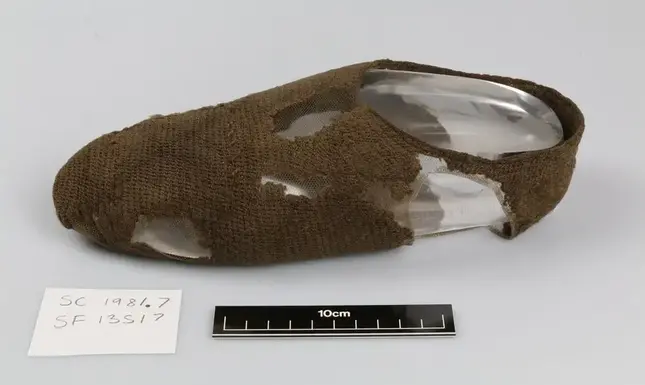
While often associated with the Viking world, it is attested earlier and elsewhere, such as in Coptic Egypt, Bronze Age Anatolia and as far back as Neolithic Israel (Maner et al. 2024). A famous example of a piece of clothing made through this technique is the ‘Coppergate sock’ found in Viking Age York, which is on display in the Yorvik Viking Centre. It is therefore safe to say that the inhabitants of Leithon could have known this technique. However, it must be said that no finds of nalbinded textiles are known from early medieval Netherlands, but the survival rate of early medieval textiles is in any case very sparse (Brandenburgh 2010).
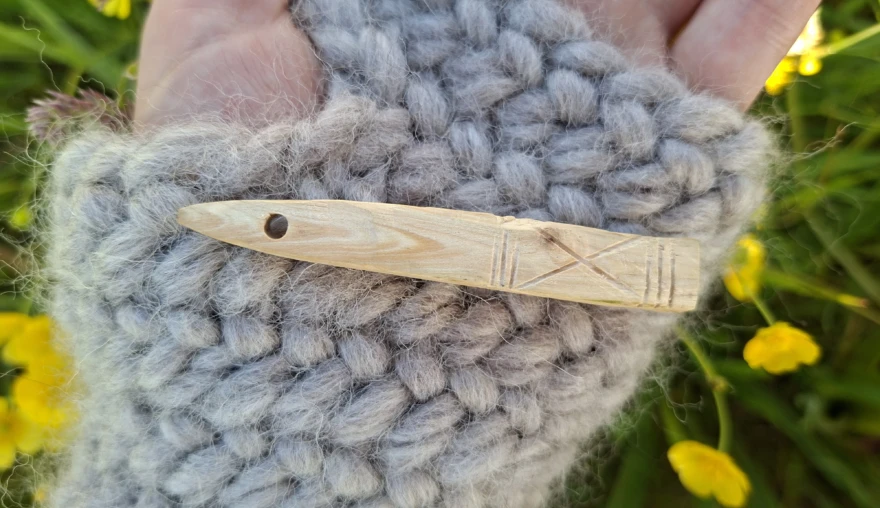
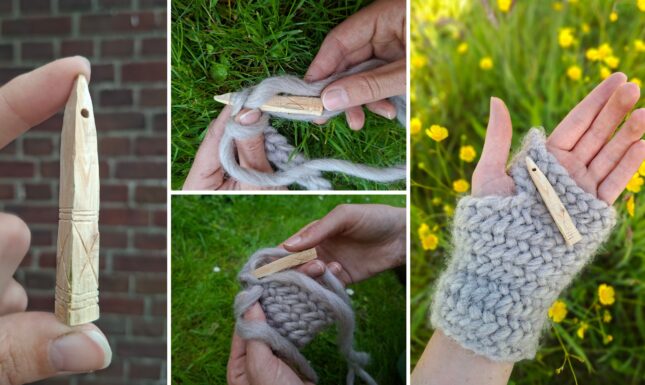
To test her theory that the Leithon ‘amulet’ could, in fact, be a nalbinding needle, Schalkwijk made a replica out of wood. This took her about an hour’s time, using the image from the excavation report as inspiration. She then proceeded to thread rather thick yarn through the eye of the needle. Following traditional nalbinding techniques, she was able to produce one single mitten in about the span of two hours, which in her experience was reasonably fast. She found the needle to be convenient and comfortable in usage, and suspects that its antler equivalent may offer an even superior level of user friendliness. The design of this needle, in contrast to the better-known flat needle, allows the user to use their thumb or palm of their hand, reducing strain on the hands and preventing injury or pain. In short, the experiment was successful and proves that the Leithon ‘amulet’ can be practically used as a nalbinding needle.
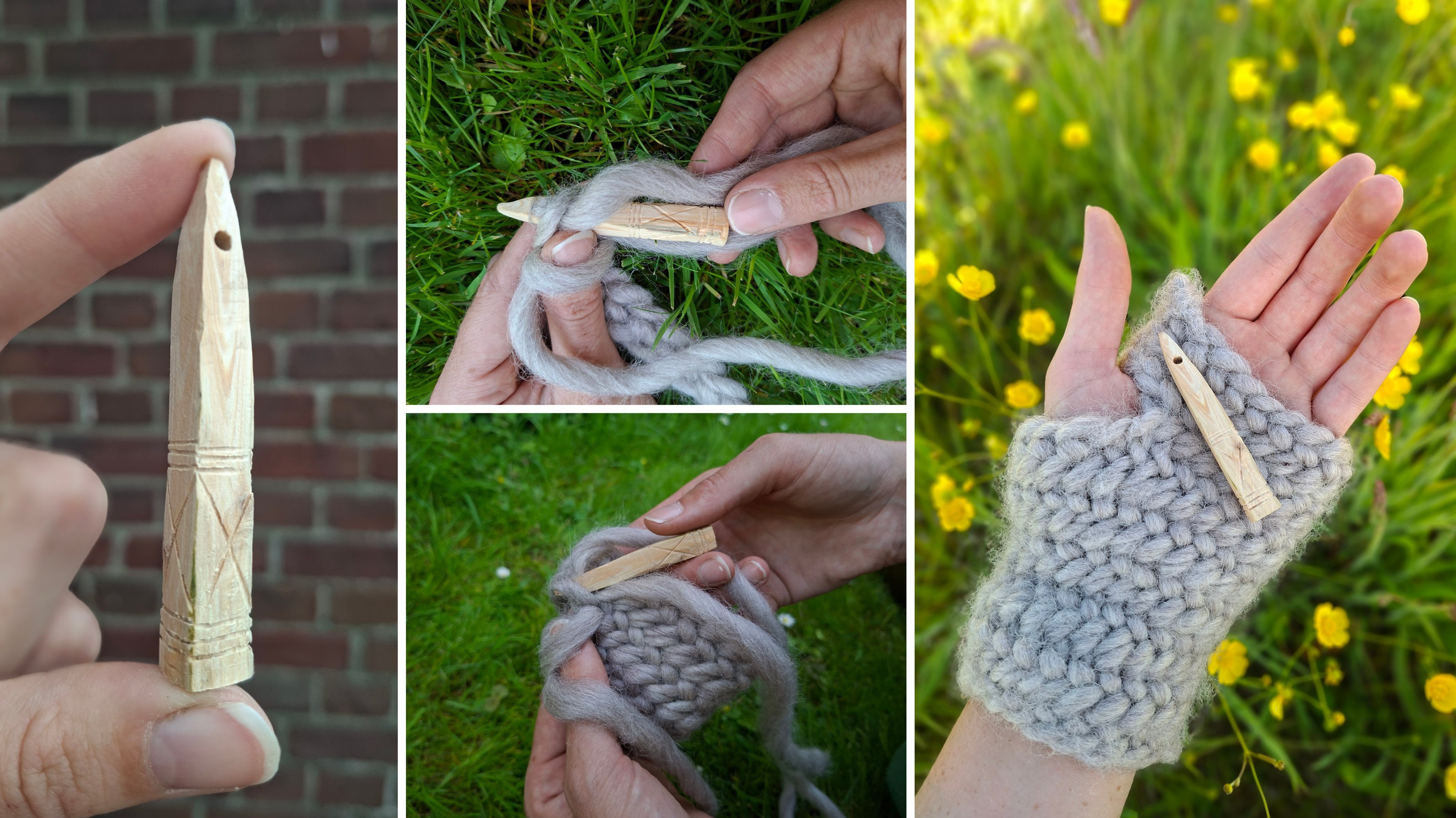
Moreover, textile production is often thought of to have been gendered in the Early Middle Ages and thus mainly (but not exclusively) performed by women (Brandenburg 2010). This would explain why the ‘Donar amulets’ are found usually in women’s graves, and not, as Werner suggests, because these ‘amulets’ were associated with fertility. The fact that they are often found in graves close to the belt supports this: medieval people hung all manner of daily objects on their belts the way we use a pocket or purse.
‘Pallia Fresonica’ and textile production at Leithon
In further support of this theory, is the fact that the Leithon ‘amulet’ was found among 400 other fragments of worked bone and antler, such as 70 needles, 304 combs, an awl, spinning bobbins and a weaving tablet. Tabletweaving (Dutch: kaartweven) is another ancient textile technique known from Prehistoric to Medieval societies that creates beautifully brocaded woven bands to decorate clothing. Interesting in this regard is that some of the other ‘Donar amulets’ mentioned by Werner are also associated with objects that look like weaving tablets.

Many of the finds from Leiderdorp - Plantage can be associated with textile production. The excavators of the site note that textile production was a prominent activity in Leithon, with its inhabitants likely producing a surplus of textile goods far above their own consumption patterns. In fact, in this time, the Frisians (who then inhabited most of the coastal Low Countries) were famous for their textile productions. At one time, Charlemagne even offered a sample of the pallia Fresonica (‘Frisian cloaks’) to the Caliph of Baghdad, Harun al-Rashid, as diplomatic gift (Notker, Gesta Karoli Magni 2.9).
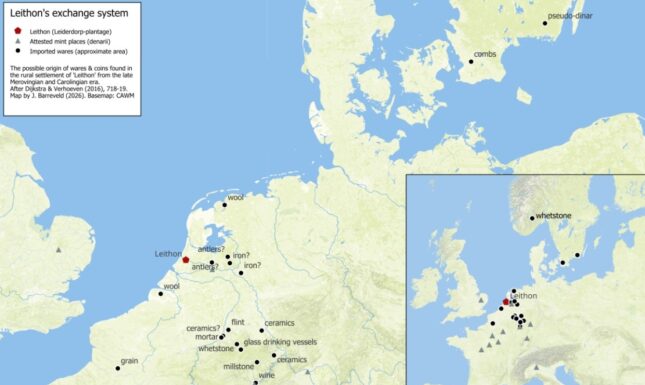
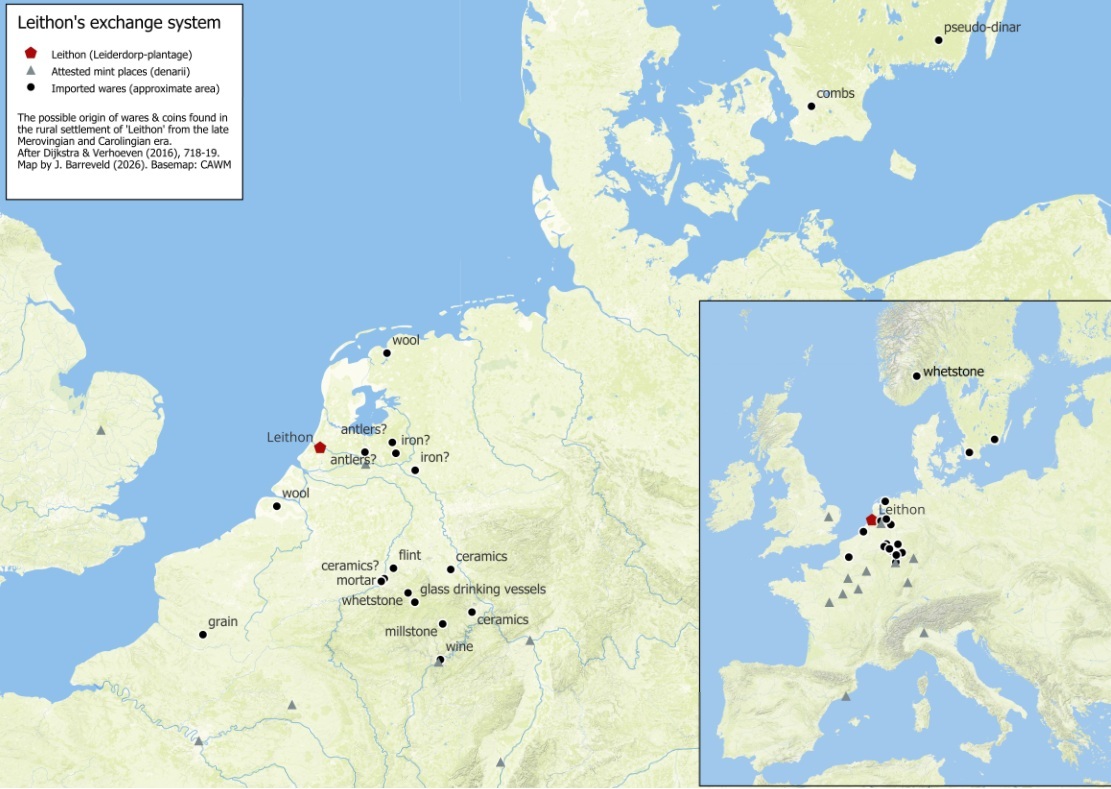
‘The needlemaker treasure’, a hoard consisting of needles, a bead and coins, may attest to the presence of a travelling merchant in Leithon involved in this kind of exchange system. It seems that Leithon may have gotten even quite wealthy from its textile production: an analysis of imported goods at the site shows that the settlement was deeply embedded in an international exchange network. For instance, there is evidence for imported wine from the Moselle valley, a whetstone from the Telemark mountains in Norway, and coins with attested mint places as far away as Barcelona and Milan. Weaving, tabletweaving and nalbinding may have created part of the wealth that allowed the people of Leithon to import these distant wares.
Amulet or needle?
To conclude, it is impossible to prove for now whether the Leithon ‘amulet’ and its equivalents were actually needles instead of amulets. It is certainly noteworthy that we stop finding ‘Donar amulets’ roughly after 700 AD, precisely when pagan practices became threatened by the rising influence of Christianity and the Church on rural communities. If these trapezoid objects were needles, why do they suddenly stop appearing in the archaeological record around this time? A final answer to the riddle presented by these fascinating objects must still be given. Nevertheless, experimental archaeology shows us how mysterious objects such as the ‘Donar amulets’ may actually have had a far more practical use than the ‘First Law of Archaeology’ would suggest!
Literature
- Brandenburgh, C., 2010: ‘Textile production and trade in Dorestad’, A.M. Willemsen and H. Kik (eds.), Dorestad in an international Framework. New Research on Centres of Trade and Coinage in Carolingian Times, 83-88
- Dijkstra, M.F.P., A.A.A. Verhoeven and K.C.J. van Straten (eds.), 2016: Nieuw licht op Leithon: Archeologisch onderzoek naar de vroegmiddeleeuwse bewoning in plangebied Leiderdorp-Plantage (Amsterdam).
- Eerden, Rob van, and Johan Nicolay, 2024: ‘Pre-Christian gods and animal symbolism, especially the worship of Wodan and Donar, in Noord-Holland (the Netherlands), 5th-8th centuries. (translation of: Voorchristelijke goden en diersymboliek, in het bijzonder de verering van Wodan en Donar (5e-8e eeuw), in: J. Nicolay and R. van Eerden (eds.), 2023: Noord-Holland in het 1e millennium (Castricum), 776-822.
- Maner, Ç, et al., 2024: ‘Untwisting Beycesultan Höyük: the earliest evidence for nalbinding and indigo-dyed textiles in Anatolia’, Antiquity 99: 403.
- Therkorn et al., 2009: Landscapes in the Broekpolder. Excavations around a monument with aspects of the Bronze Age to the Modern (Amsterdam), 107-108, 186-189.
- Werner, Joachim, 1964: ‘Herkuleskeulen und Donar-Amulett’, Jahrbuch des Römisch-Germanischen Zentralmuseums Mainz 11, 176-197.
© Jip Barreveld, Jolijn Schalkwijk and Leiden Medievalists Blog, 2026. Unauthorised use and/or duplication of this material without express and written permission from this site’s author and/or owner is strictly prohibited. Excerpts and links may be used, provided that full and clear credit is given to Jip Barreveld, Jolijn Schalkwijk and Leiden Medievalists Blog with appropriate and specific direction to the original content.