Queens, Crisis, and Coinage at the End of the Sasanian World

Coins were more than currency in the pre-modern world. They were among the most public expressions of political authority. In the final decades of the Sasanian Empire, the coinage of female rulers offers a rare glimpse into how authority was asserted amid dynastic crisis and imperial collapse.
Imagine handling a silver coin in seventh-century Iran. On one side is the familiar image of a crowned ruler. On the other is a fire altar flanked by attendants, a design that had appeared on Sasanian coins for centuries. At first glance, there is nothing unusual about it.
Then you read the inscription...
The ruler is not a king...
She is a queen...
For a brief moment in the final years of the Sasanian Empire, some of the most familiar coins in the Middle East carried the names of women. Among them were Boran (630 and 631 - 632 CE) and Azarmidokht (630 - 631 CE), daughters of the ruling dynasty who found themselves on the throne during one of the most chaotic periods in Iranian history (14 Emperors in a 4 year period!). Their reigns were short. Their political success was limited. Yet their coins survive as remarkable witnesses to a world falling apart. At first glance, these issues seem exceptional because they feature female rulers. But the more interesting story is not about gender alone. It is about what happens when an empire begins to unravel.
Coinage is often associated with stability. Kings come and go, but money remains reassuringly familiar. Yet the coins of Boran and Azarmidokht remind us that even the most conservative monetary systems can reveal signs of political crisis.
And by the early seventh century, the Sasanians had entered exactly that kind of territory.
Keeping Up Appearances: The Sasanian Coinage Machine
One of the remarkable things about Sasanian coinage is how little it changed. For more than four centuries, the empire produced silver drachms that followed a highly recognizable pattern. The ruler appeared on the obverse wearing an elaborate crown, while the reverse displayed a Zoroastrian fire altar flanked by attendants. Individual rulers introduced new crowns and minor stylistic changes, but the overall formula remained remarkably stable.
This consistency was no accident. Coins were one of the most visible expressions of royal authority. They circulated across Iran, Central Asia, Mesopotamia, and beyond, passing through countless hands. Familiar designs reassured users that the state remained functional and that the silver in their pockets retained its value. In many ways, Sasanian coinage was the medieval equivalent of a national logo. People recognized it instantly.
The problem came when the political system behind that logo began to crack. Alongside these late Sasanian examples, it is also worth briefly noting the earlier appearance of female authority in Iranian monetary traditions, including figures such as Musa of Parthia (Fig. 1; 2 BCE – 4 CE). While separated by several centuries and very different political contexts, these precedents form part of a longer Iranian tradition in which questions of dynastic legitimacy could, in exceptional circumstances, accommodate female rulership.
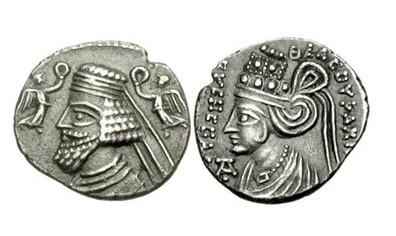
Rather than functioning as direct models, they provide a deeper historical background against which later Sasanian developments can be understood as moments of intensified political stress within a much older and more flexible repertoire of sovereignty. By the beginning of the seventh century, the Sasanian Empire had entered a period of extraordinary turmoil. Decades of warfare against the Byzantine Empire had strained resources and weakened royal authority. Court intrigue intensified. Noble families gained influence. Succession disputes became increasingly frequent.
The result was a succession crisis that would have been difficult for even the most stable state to survive.
And yet the coins kept looking reassuringly normal.
Boran's Impossible Task
It would be easy to present Boran and Azarmidokht simply as exceptional women who reached positions of power in a male-dominated society.
That story is certainly part of the picture.
But Boran’s coins suggest something even more interesting.
These rulers appear at a moment when traditional structures of authority were under immense strain. Their reigns tell us as much about the fragility of the Sasanian state as they do about female rulership. The coins survive not because the empire was functioning smoothly, but because it was struggling to function at all.
When Boran came to power around 630 CE, she inherited a situation that bordered on catastrophic. Her father, Khosrow II, had overseen one of the largest expansions in Sasanian history before suffering a dramatic downfall. Following his overthrow and execution, the empire entered a dizzying cycle of short-lived rulers, palace coups, and factional struggles (Daryaee 2014: 34–35; Pourshariati 2008: 209).
Boran was one of several attempts to restore order.
Modern readers sometimes focus on the fact that she was a woman ruling in a traditionally male role. Contemporary concerns, however, were probably more immediate. The empire was fragmenting. Rival factions competed for influence. The question was not whether a woman could rule, but whether anyone could restore stability.
Her coinage reflects this challenge. Boran did not introduce a revolutionary new design. She did not abandon established traditions or seek to create a distinct visual identity. Instead, her coins look unmistakably Sasanian.
That was the point.
The message was simple: the system still works.
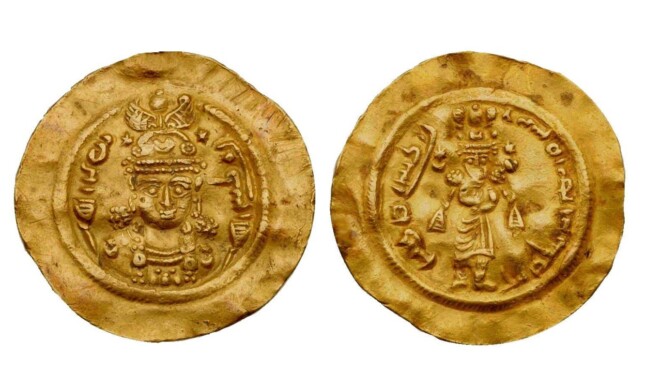
This was emphasised by the phrase ‘Boran, restorer of the race of Gods’ written on the coins (See Fig. 2; Daryaee 2014: 35–36). The familiar imagery of crowns and fire altars reassured subjects that legitimate authority remained intact. The empire might be experiencing political turmoil, but the language of kingship continued unchanged. Coinage became a promise that continuity was still possible. Whether people believed that promise is another matter.
A Queen in a Dying Empire
If Boran's reign was difficult, Azarmidokht's was arguably even more precarious.
By the time she ascended the throne, the Sasanian political system was operating under immense pressure. Powerful aristocratic factions increasingly dominated decision-making, while the authority of the crown continued to erode (Baca-Winters 2025: 18-19; Pourshariati 2008: 204).
Like Boran, Azarmidokht ruled only briefly. And like Boran, her coinage remained remarkably conventional.
At first glance, this can seem surprising. We often expect periods of crisis to produce dramatic change. Yet monetary systems frequently behave in exactly the opposite way.
When governments become unstable, they often cling even more tightly to familiar symbols and established practices. Innovation introduces uncertainty. Continuity provides reassurance.
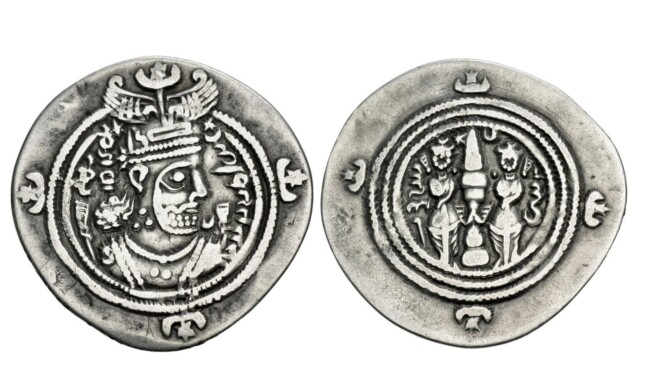
As a result, the coins of Azarmidokht do not advertise a new political order. Instead, they attempt to preserve the appearance of an old one. Considering her name literally means ‘daughter of the respected one (Her father Khusrow II)’ (Daryaee 2014: 80). She even differs from her sister because although Azarmidokht is written on the coins, her respected fathers bearded face is still clearly there (Baca-Winters 2025: 20).
In a sense, that is what makes them so fascinating.
They reveal a state trying desperately to look stable at precisely the moment when stability was becoming impossible.
The End of an Empire, Not of a Monetary Tradition
The coins of Boran and Azarmidokht are easy to overlook.
Numismatically, they fit comfortably within the broader Sasanian tradition. Their designs are familiar. Their inscriptions follow established conventions. They do not immediately stand out as revolutionary objects.
Yet that familiarity is precisely what makes them so revealing.
The story becomes interesting when viewed from a longer perspective.
Within a few years of Boran and Azarmidokht's reigns, Arab armies would begin conquering large portions of the Sasanian Empire. By the middle of the seventh century, the dynasty itself had disappeared.
Yet the coinage did not vanish overnight.
These coins were struck during one of the most turbulent periods in Iranian history. Their conservative appearance masks a world of dynastic conflict, political fragmentation, and imperial decline. Far from announcing dramatic change, they insist that continuity remains possible.
Early Islamic rulers inherited much of the Sasanian monetary system and initially saw little reason to replace it. Arab-Sasanian coins continued to use familiar imagery, mint structures, and weight standards. In some cases, the changes were surprisingly modest.
This continuity reminds us that political collapse does not necessarily produce immediate monetary revolution.
Empires may fall quickly. Monetary habits often survive much longer.
The coins of Boran and Azarmidokht therefore occupy a fascinating position in history. They belong simultaneously to the end of one world and the beginning of another. They are among the last expressions of Sasanian sovereignty, but they also form part of the foundation upon which early Islamic monetary systems would be built.
Works Cited:
- Baca-Winters, K. 2025. To Walk in Royal Ways: the Lives and Legacies of Bōrān and Āzarmīgduxt. Old World: Journal of Ancient Africa and Eurasia. 5 (2): 1–33.
- Daryaee, T. 2014. Sasanian Persia: The Rise and Fall of an Empire. London: I.B. Tauris.
- Kuntz, R., and W. Warden. 1983. A Gold Dinar of the Sasanian Queen Buran. Museum Notes. 28. The American Numismatic Society: 133–5
- Pourshariati, P. 2008. Decline and Fall of the Sasanian Empire: The Sasanian-Parthian Confederacy and the Arab Conquest of Iran. London: I.B. Tauris.