

Military Metamorphosis? Warfare in the Northern Netherlands, 1400-1560.
From knights to mercenaries, from catapults to cannons, and from civic levies to professional armies: in my PhD I will examine the radical changes warfare in the Northern Netherlands underwent during the late Middle Ages.
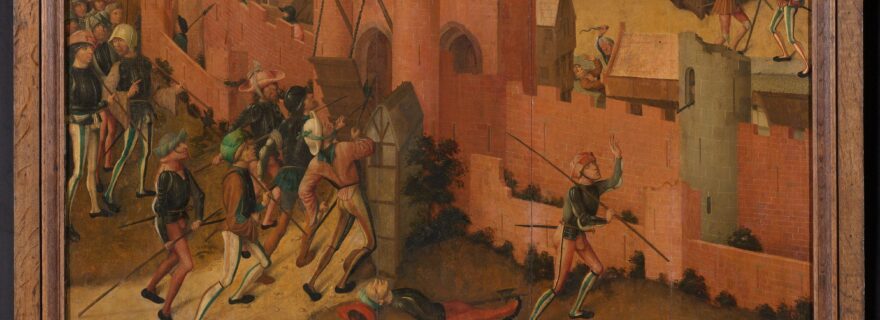
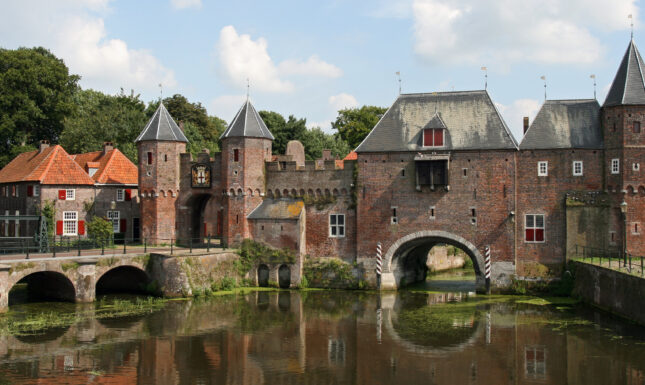
On 30 Oktober 1427, Philip the Good (b. 1396; d.1467), Duke of Burgundy, began a siege of the city of Amersfoort. His goal was to subjugate the city and be able to install a – for him at least – favourable man as prince bishop of Utrecht, something the city had actively opposed. The siege was fierce and lasted three days in total, but in the end the city held. According to legend, even the children and women aided in the defence. They carried buckets of quicklime and water to throw over the Burgundian attackers, to burn them alive in their armour. After the siege, it took eight days to bury all the bodies scattered around the city and many of the banners captured by Amersfoort were hung in the St. Joris church.
116 years later, on 4 July 1543, the infamous Guelders marshal Maarten van Rossum (b. 1490; d. 1555) appeared before the city gates with roughly 4000 or 5000 infantry and 1200 horsemen. Even though Van Rossum had, for that age at least, no large artillery train equipment with him, it took him just five storm attacks before the town capitulated – that which Philips the good had failed to do. After the siege, Amersfoort was forced to pay a large sum of money to prevent the ransacking of the town.
While in the beginning of the fifteenth century Amersfoort could withstand the full might of a Burgundian ducal army, roughly 110 years military might had developed such that even an army without heavy artillery could capture well defended smaller cities.
Military Revolution Theory
Traditionally this development in military power has been examined through the lens of Military Revolution Theory (MRT), first proposed by Michael Roberts (1955). He argued that new tactics and organisational reforms transformed war during the late sixteenth and seventeenth century and lead to massive armies, who in turn drove the rise of the early-modern state. Twenty years later, Geoffrey Parker (1976/1988) built on Roberts’ theory and argued it was not battlefield tactics but siege warfare that drove military change. The growing power of artillery and the bastion fort introduced in early sixteenth-century Italy, demanded ever larger armies to besiege these structures. Again, he argued it was the increase in army size that led to the emergence of the early-modern state. After Parker's 1988 book, MRT became one of the most influential paradigms in military history, encouraging researchers to detect many other ‘military revolutions’ throughout history, particularly in Europe.
In short, MRT spearheaded the development of military history from an internally focused, more or less esoteric study to a discipline demonstrating the effects warfare had and has on human societal development and the consequential necessity to study military development.
Warfare in the Northern Netherlands as a Case Study
Of course, like many other meta-theories, MRT could count on much criticism, however, for example, for simplifying the diversity of the past into an idealised narrative, for assuming military development followed a revolutionary rather than evolutionary trajectory, and that it follows a too simplistic causal path and does not reckon for the complex mechanism of historical change. As an archaeologist, my personal critique is that within MRT technology is often taken as one of the main drivers of military change, but that historical objects making the supposed change are never studied themselves. Therefore, in my PhD, I will respond to these critiques by proposing a new military model, grounded in emergence and complex adaptive systems, to explain historical military development and will actively integrate object analysis.
As the above examples of Amersfoort demonstrate, warfare fought on the Northern Netherlands (above the rivers Waal and Meuse) between 1400 and 1560 can be a good case study to test this new model. Interestingly, except for few larger studies – like Leiden’s own Hans Mol’s (2017/2022) work on the Friese popular militia (1480-1560) and Louis Sicking (e.g. 1998/2004) research into Dutch medieval naval armed sources – military Dutch historical research has largely been solely focussed on the Eighty Years War or the thirteenth and fourteenth century. This, while many conflict were fought during the fifteenth and early sixteenth century leaving the countryside and many cities devastated, such as the Hook and Cod Wars (1345-1492), the Sticht Wars (1456-8), the Utrecht Wars (1480-1492), and the Guelders Wars (1502-1543), just to name a few. This lack of focus on these conflicts is regrettable, as a host of narrative (e.g. chronicles), archival (e.g. financial accounts and diets), and archaeological sources (e.g. remains of city walls and hundreds of extant pieces of arms and armour), providing insight into these wars, have largely been left untouched. Consequently, my PhD will not only aid in better understanding how and why military historical change occurred, moreover, it fills in a lacune in the Dutch medieval historiography.
A New Paradigm? Emergence & Complex Adaptive Systems
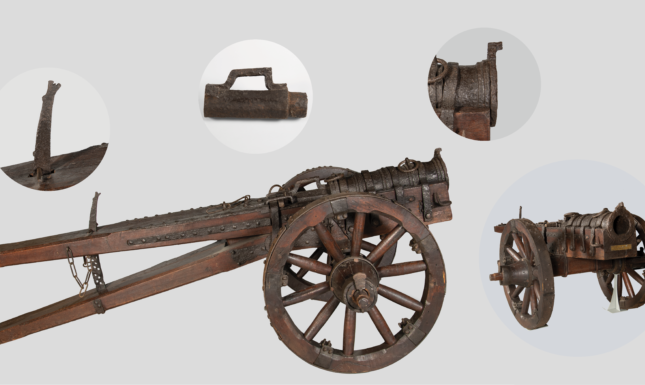
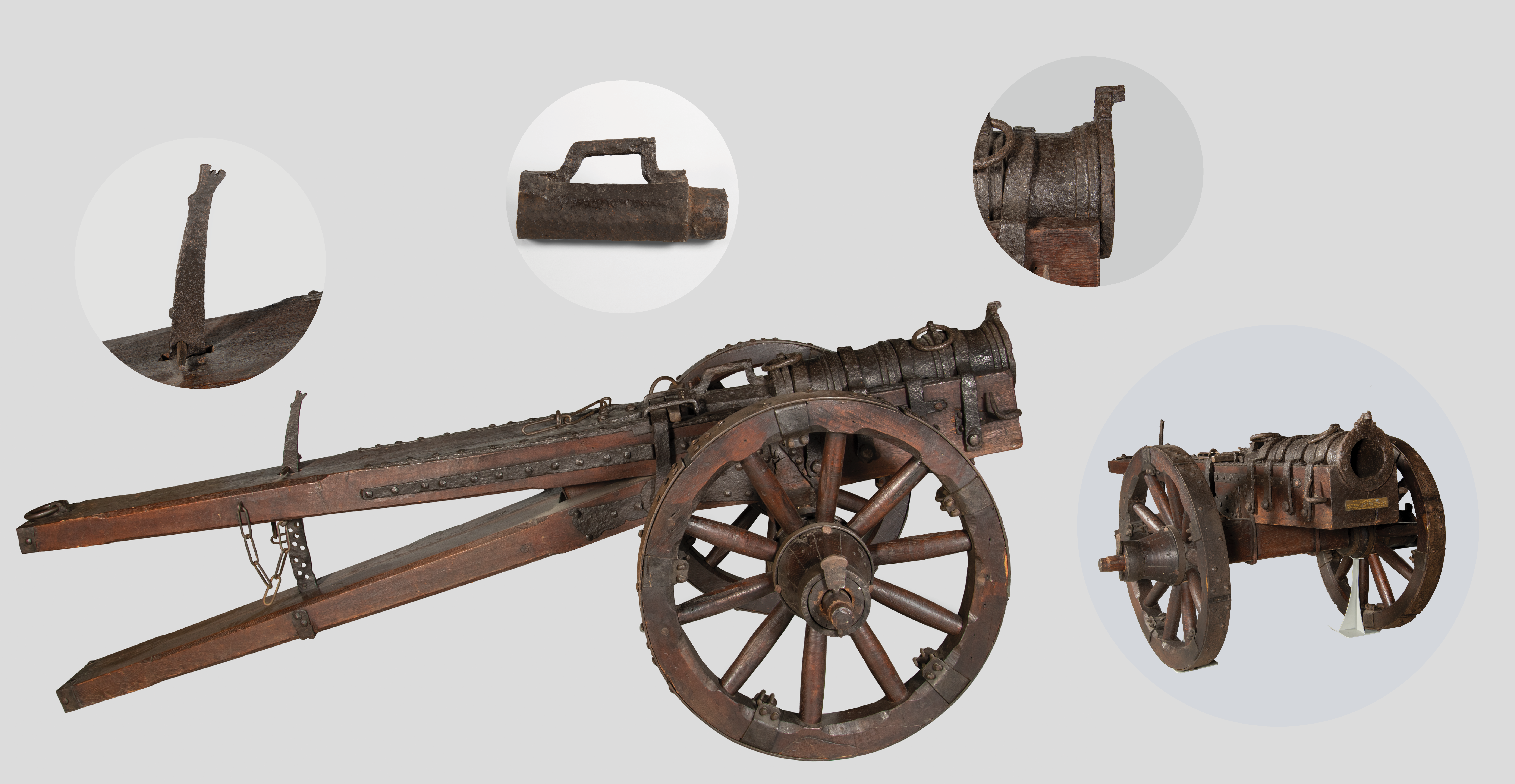
Instead of focussing on how fast military development happened (evolution vs. revolution), in my PhD I will concentrate on more fundamental mechanism of change. These can be expressed by the ideas of emergence and aggregativity, as propose by the philosopher of science William C. Wimsatt (e.g. 2000). Emergence can be defined as macrolevel behaviours arising out of the interactions of microlevel components, yet these behaviours are not present in the microlevel components themselves. Think of a medieval cannon shooting a stone ball. While none of the individual components (barrel, stone ball, gunpowder) can shoot the ball on their own. It is only through their specific organisation – gunpowder in the barrel, then the bullet, followed by lighting the gunpowder – the components gain the ability to shoot the bullet.
Aggregativity is the opposite of emergence. In aggregativity, the micro- and macrolevel components have the same properties, just in different quantities: ‘the whole is equal to the sum of its parts’. For example, how adding an extra pikeman to a pikeblock does not fundamentally change its military power, it merely adds the power of that extra pikeman.
Taking an emergence-aggregativity perspective, requires taking a system analytical view. Only when the whole system is analysed – including all its individual part and their relations – can be discovered if emergence happened in historical military development. If this is the case, I will call this a military metamorphosis, named after Ovid’s his masterwork metamorphosis (8 CE), wherein many of actors spontaneously change into new forms. Military, however, can be seen as a special type of system, called a complex adaptive system (CAS). One of the hallmarks of complex adaptive systems is decentralised, multilevel causality, meaning not a single cause can be designated as the origin of change. Thereby, they challenge the often-single causal structure of older MRT literature and new methods of causality analysis must be made.
Medieval Battle & Weapon Analysis
To discover whether military change in the Northen Netherlands followed an emergent or aggrative pattern, I will compare circa fifteen battles, sieges, and plunderings that were fought between 1427 and 1543. For each of these military events, I will create a detailed description of what happened, where, and when. For instance, answering question like: how long did the siege last, where was the siege camp and artillery located, or on which days were storm attacked made and where these successful?
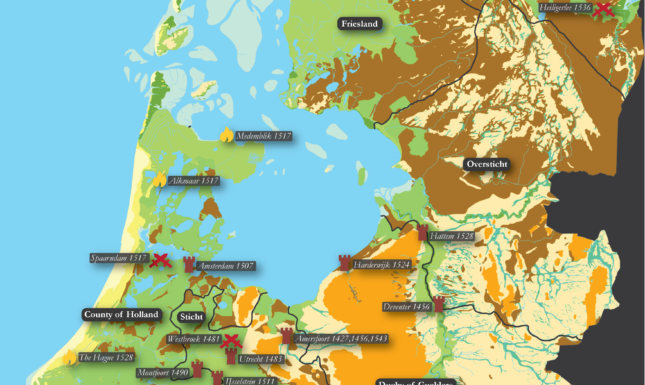
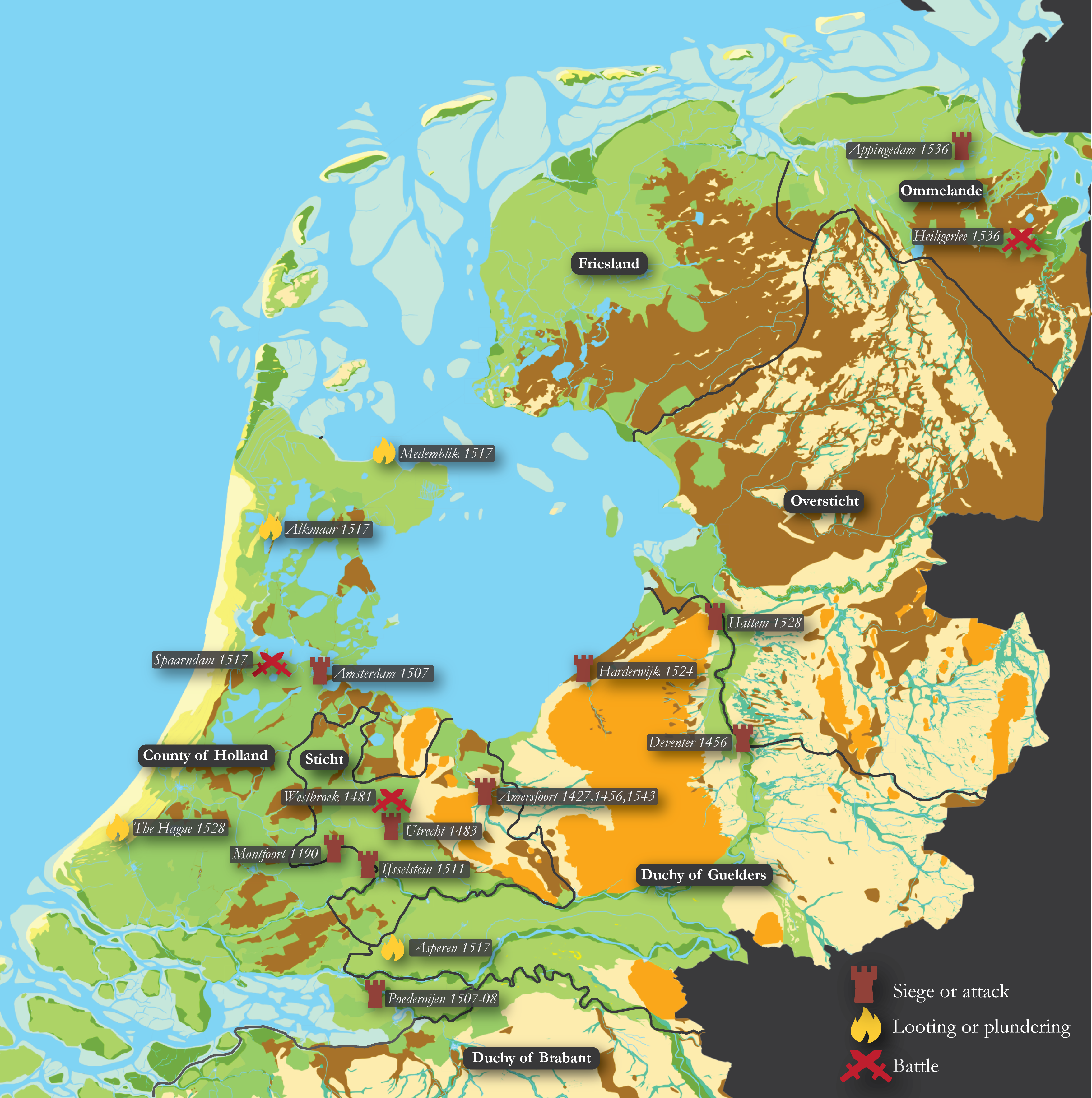
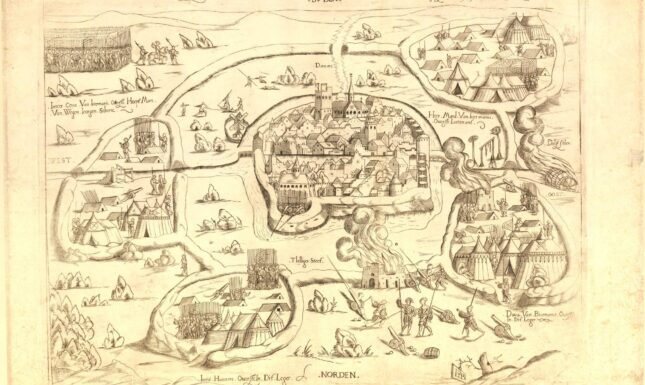
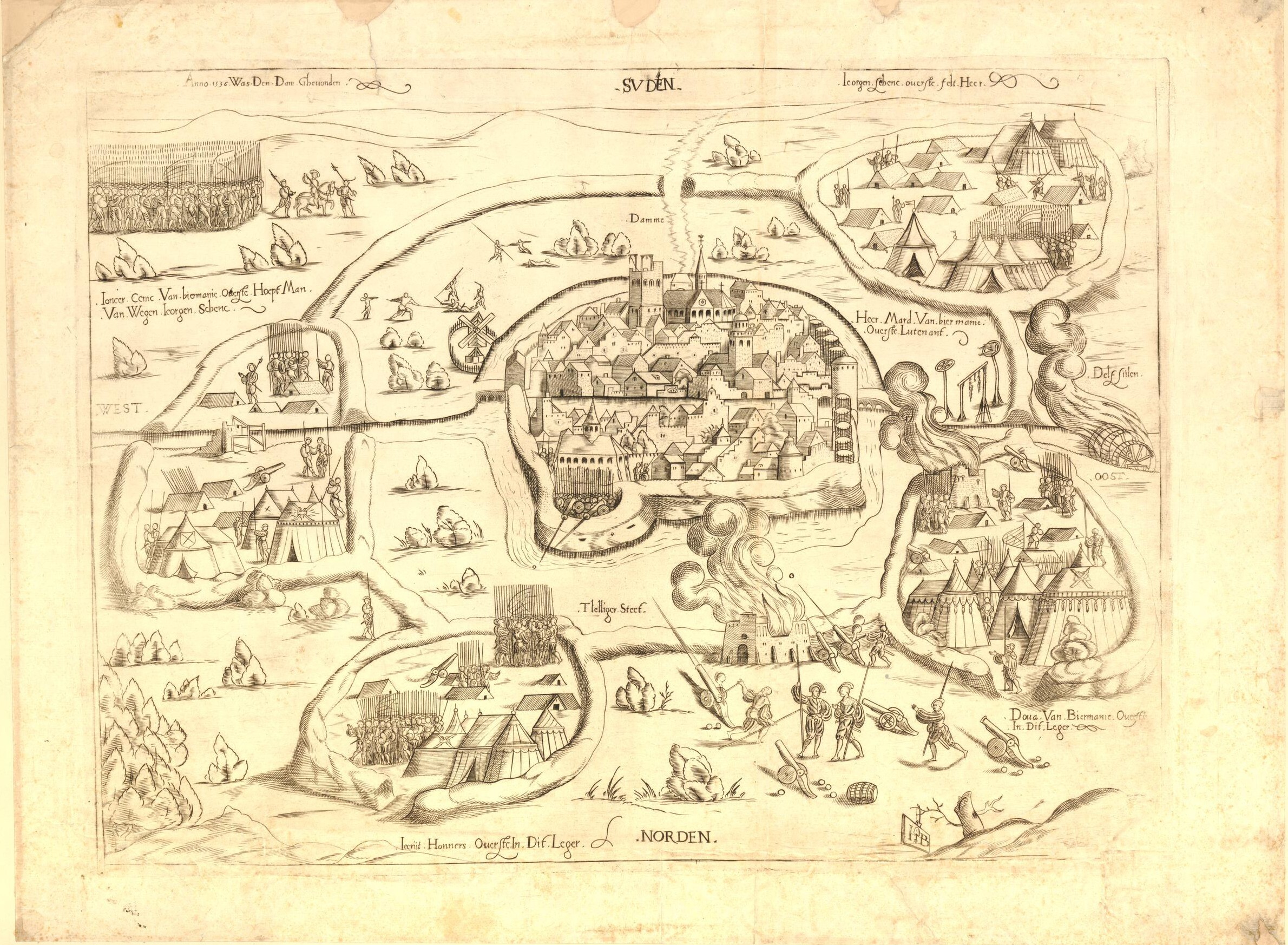
I will base this description by analysing different sources: from medieval chronicles to gain a general idea of what happened, to financial accounts to understand which weapons and armours were bought for the battle or how many men were hired specifically, to old maps and excavation to understand how the landscape looked and how well cities and castles were defended.
To better understand the development in technology, I will analyse more than 200 different archival documents dating between 1400 and 1558, describing the armaments of citizens, castles, and cities, including: 42 muster rolls (monstercelude) listing citizens and their personal weapons, 140 inventories of which 86 describe the artillery encountered in castles in Holland, and 36 judicial documents (keurboecken) decreeing either the mandatory ownership of arms & armour or banning the openly carrying of certain weapons. Only by combining all these sources different sources, it is possible to grasp how and why military changed so dramatically during the late Middle Ages in the Northern Netherlands.
These dramatic changes raise a number of key questions and themes I will ultimately explore in my PhD. For example, how and when did gunpowder weapons develop, especially when were cast-iron bullets introduced that had greatly improved the impact artillery had? When did the famous Landsknecht units come to the Netherlands, how did they operate, and were they mainly foreign mercenaries – as current literature suggest – or did people from the Netherlands also join them? And what happened to castles: did they really become obsolete because of new artillery – as Parker argued – or did their role simply change? Finally, were warfare and the rise of the early modern state actually closely connected in this period – as is sometime suggest (“war made the state, and the state made war”) – or is there more going on?
Keep posted and in the coming years I aim to provide answers to each of these questions – and hopefully many others as well.
Further reading:
Mol, J. A. (2017). De Friese volkslegers tussen 1480 en 1560. Hilversum, Verloren.
Mol, H. (2022). The Frisian Popular Militias between 1480 and 1560. Amsterdam, Amsterdam University Press.
Parker, G. (1976). "The "Military Revolution," 1560-1660- a Myth?" The Journal of Modern History 48(2): 195-214.
Parker, G. (1988). The Military Revolution. Military Innovation and the Rise of the West, 1500-1800. Cambridge, Cambridge University Press.
Roberts, M. (1956). The Military Revolution, 1560-1660: An Inaugural Lecture Delivered Before the Queen's University of Belfast. Belfast, M. Boyd.
Sicking, L. (1998). Zeemacht en Onmacht. Martitime politiek in de Nederlanden 1488-1558. Amsterdam, De Bataafsche Leeuw.
Sicking, L. (2004). Neptune and the Netherlands. State Economy, and Wat at Sea in the Renaissance. Leiden, Brill.
Wimsatt, W. C. (2000). "Emergence as Non-Aggregativity and the Biases of Reductionisms." Foundation of Science 5: 269-297.
© Casper van Dijk and Leiden Medievalists Blog, 2026. Unauthorised use and/or duplication of this material without express and written permission from this site’s author and/or owner is strictly prohibited. Excerpts and links may be used, provided that full and clear credit is given to Casper van Dijk and Leiden Medievalists Blog with appropriate and specific direction to the original content.