
Bigger isn’t Better: Why a large house doesn’t mean more wealth, an Early Medieval example from the central Netherlands

Shrinking byrehouses in early medieval Ede reveal more than changing architecture: they signal a fundamental shift in livelihood, from self-contained communities to outward-oriented households dependent on new forms of exchange and land use, and new social ties.
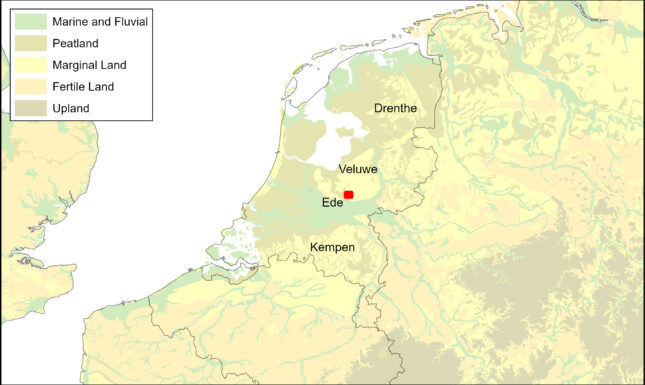
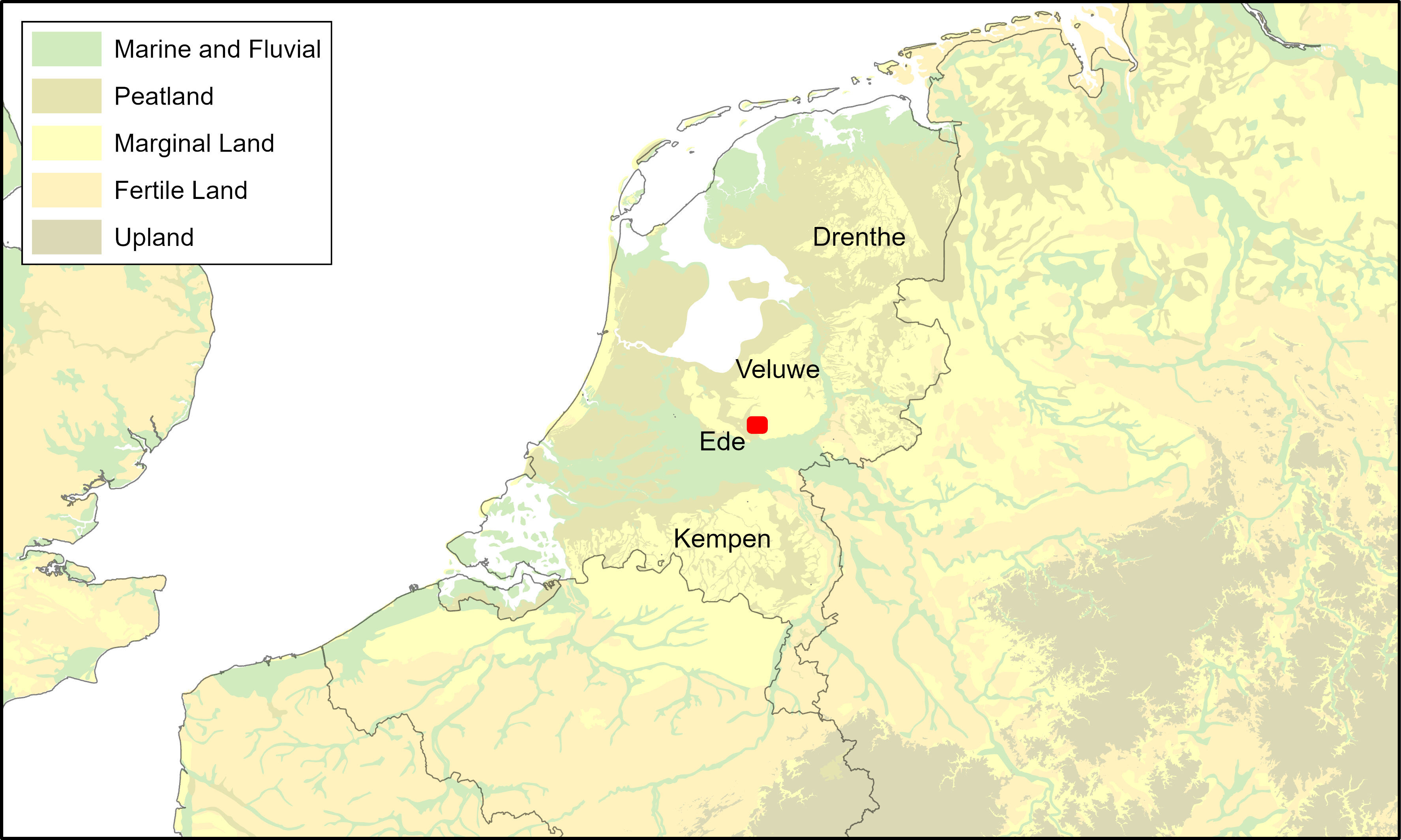
Understanding agricultural life in the post-Roman countryside is notoriously difficult. Especially in the sandy landscapes of the central and eastern Netherlands (Figure 1), since organic preservation is poor, settlement excavations are often partial, and ecofactual datasets are thin. Yet even in these constrained contexts, longhouses—and especially their byres—offer a surprising window into the organization of agricultural production, and therefore into the livelihoods of, say, 99% of the population. Building on the argument that cattle husbandry—and specifically dairy cattle husbandry—is the structural backbone of these communities, I hope to demonstrate that changes in byre size are not simply architectural developments or stylistic shifts. Instead, they reveal fundamental differences in household economies, social networks, and land use.
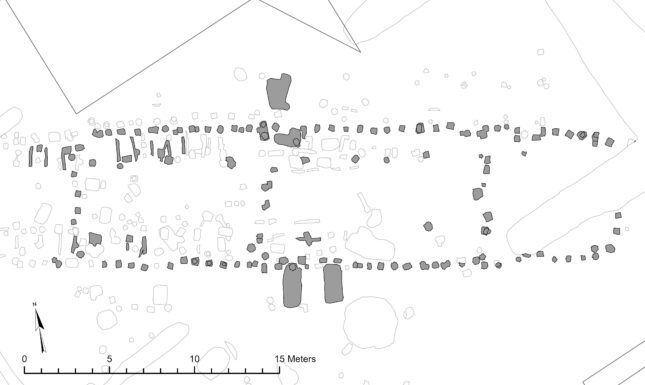
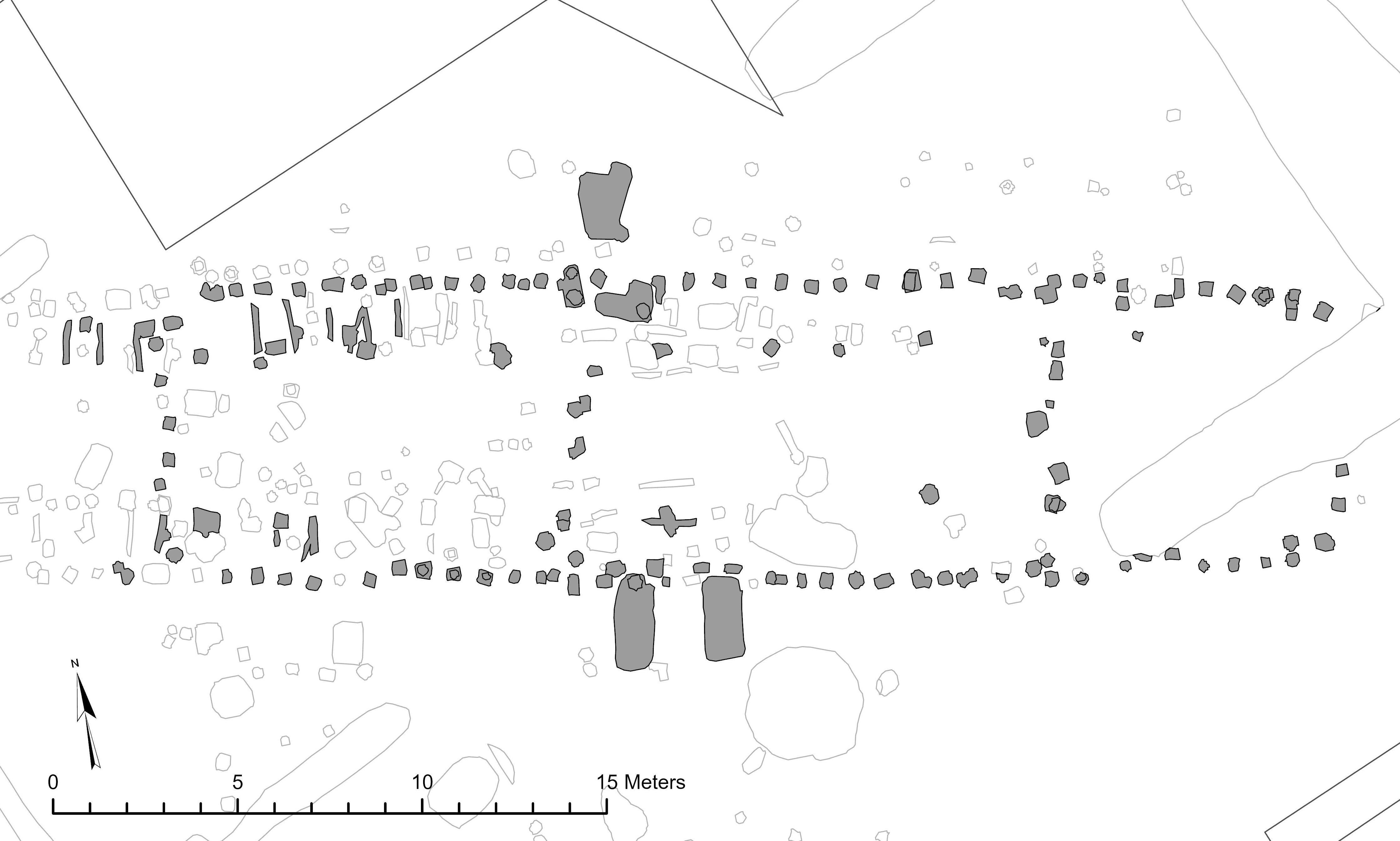
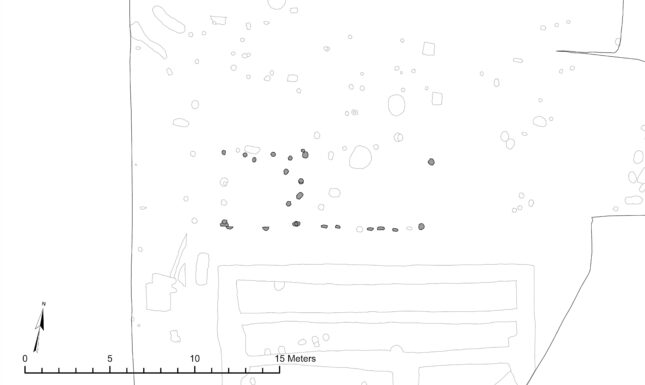
Across most archaeological periods, the internal layout of byre‑houses remains remarkably stable: a byre section, a central working area, and a living section (Hamerow, 2002). What does change dramatically between the Late Roman and early medieval period is the length of the byre—and therefore the number of cattle a household could maintain (and see Figures 2 and 3).
Cattle are the most plausible occupants of byres because they are the only livestock that benefit from being kept close to people on a daily basis (Zimmermann, 1999). Dairy cows in particular must be socialised to tolerate milking; this requires continuous, intimate contact that fits naturally within the combined living-and-stalling space of the longhouse. The stalls found in many byres also match the size and spacing needed for large bovines rather than sheep or pigs (Olausson, 1999; Waterbolk, 1975). Other animals either do not require such close supervision—sheep can be kept in extensive outdoor herds, pigs do not need the indoor segmentation (boxes)—or are present in far smaller numbers, as with workhorses.
It is unlikely that these cattle were kept primarily for meat. A meat-focused system would not require daily handling of the animals, and no byre would be needed since a meat herd would best be left to roam freely in a semi-feral state (Ingold, 1980; Zimmermann, 1999). Milk, by contrast, provides a steady caloric return that better meets the needs of a subsistence household than occasional slaughter, which also risks spoilage. The byre, therefore, points towards a dairy-based system: an investment in keeping animals tame, accessible, and productive on a daily basis.
The economy of having cattle
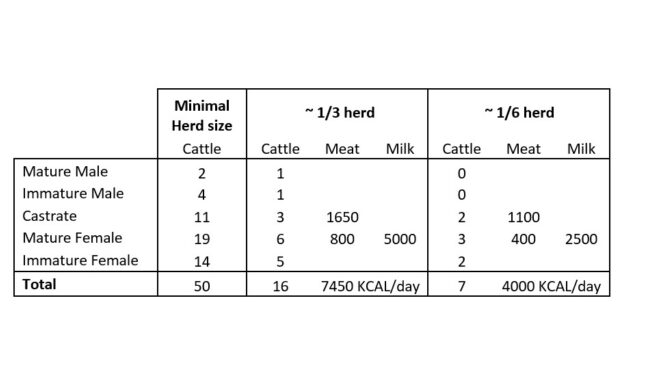
A functioning herd requires a minimum of (around) fifty animals to maintain its biological self‑reproducing capabilities (table 1). A herd in this context is a biological concept. A herd is a self-reproducing cattle population that may be distributed between owners and stabled in various byres, pens or other enclosures or allowed to roam a territory freely. It is important to note that there must always be ‘unproductive’ (not milk-producing) bulls and bull calves in a herd to remain self-reproducing.
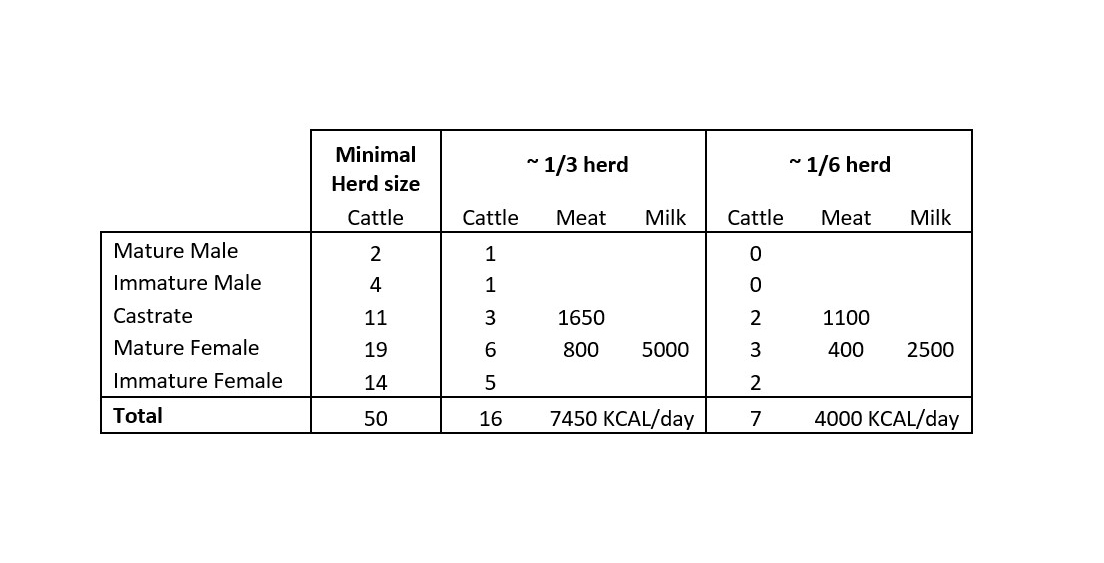
Furthermore, a byre is never filled to its theoretical maximum because livestock numbers fluctuate constantly. Calves are born, animals fall ill and mature animals eventually die and are slaughtered. Moreover, the number of cattle a household can manage is limited not only by stall space but by the number of people available to care for them, which changes as the number of people in the household changes through time: children are born and adolescent children leave to form new households (which must receive cattle as part of their marriage arrangements, since no new household can begin with an empty byre). The number of cattle in the byre, therefore, reflects not a fixed number but a moment within the household life‑cycle.
Byre-Houses as Livelihood Indicators, not Wealth Indicators
Following the same logic, a byre section measuring c. 10 m (see Figure 2) is estimated to have accommodated approximately 16 cattle, representing roughly one-third of a viable, self-reproducing dairy herd. This implies that a household of (for example) five persons could receive 75% of its daily caloric need from milk and the occasional slaughter products from this byre alone (Emaus, 2024, pp. 187–188). And since no pastoral community ever has only cattle, but oftentimes keeps a small vegetable patch, some pigs and/or sheep, and hunting or gathering opportunities on the side (Chang & Koster, 1986; Dyson-Hudson & Dyson-Hudson, 1970; Evans-Pritchard, 1940). This could mean it is a predominantly non-arable farming and pastoral community.
The economy of a household with a byre of only five metres (see Figure 3) —and thus room for roughly seven cattle—differs fundamentally from that of the larger units. With so few animals, the caloric return from milk and meat drops sharply to about 40% (Emaus, 2024, p. 188), meaning that secondary food‑producing activities must take on a far greater share of the household’s subsistence. At the same time, a smaller herd produces less manure, which reduces the effectiveness of any horticultural or arable pursuits. Although the manure from seven cattle can still enrich a modest grain plot, maintaining such a field requires more labour and more careful selection of soils with good natural fertility (which isn’t really an issue in the pastoral scenario). In this scenario, the byre is no longer the major source of calories, and arable cultivation, foraging, small stock, and other secondary practices inevitably become central to the economic balance of daily life.
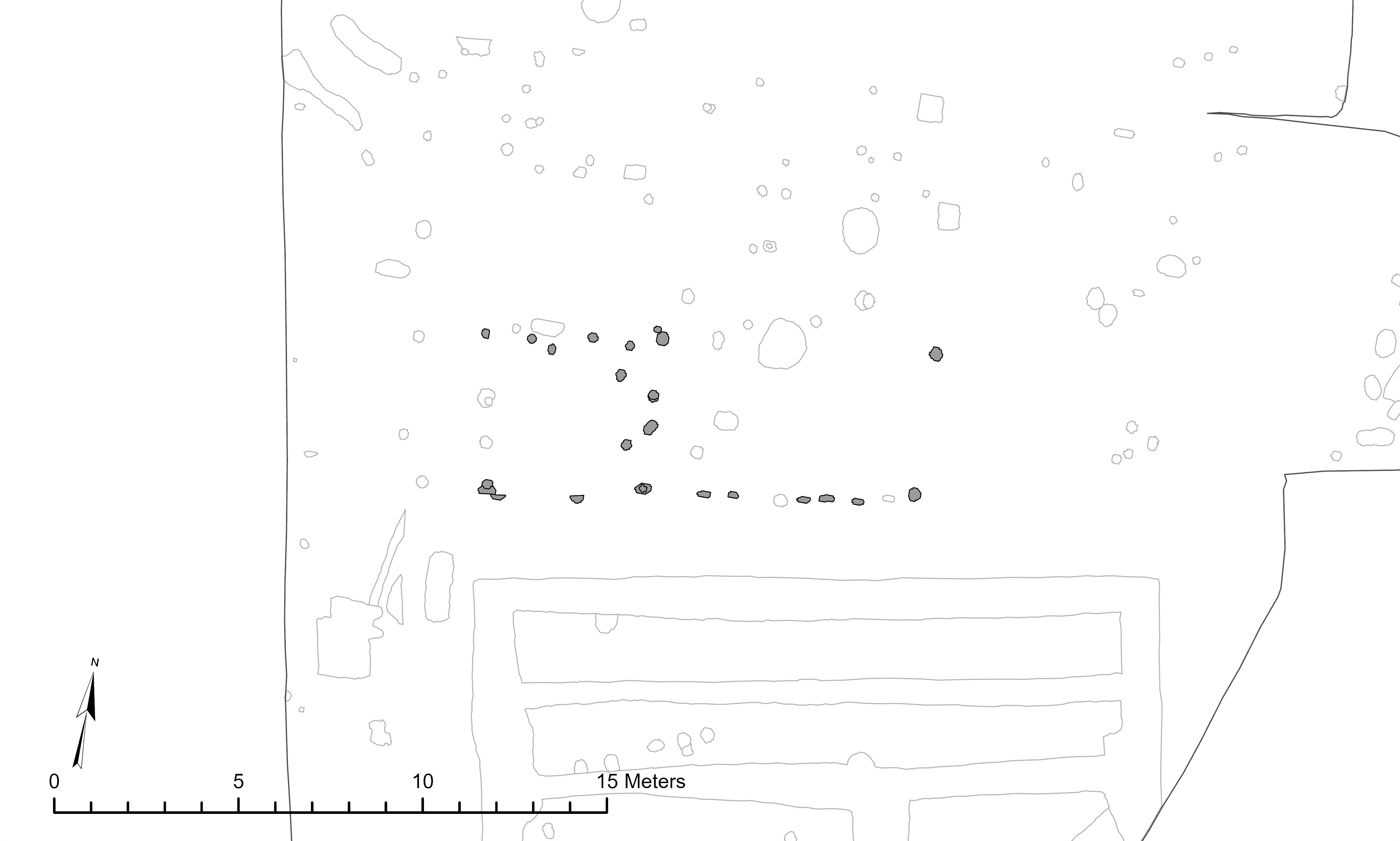
Thus, byre size can function as a proxy for the scale, autonomy, and orientation of the household economy. The main point I want to make here is that this is not just simply an indicator of wealth or surplus production (Emaus, 2024, p. 190). Simple arithmetic (more cows equals more status) is evidently too simplistic.
A 5th-Century Full-Herd System
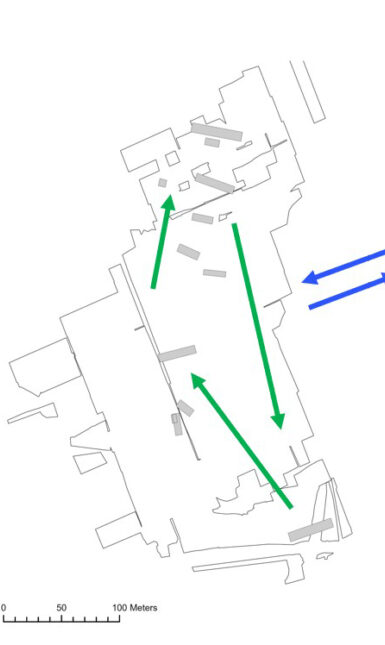
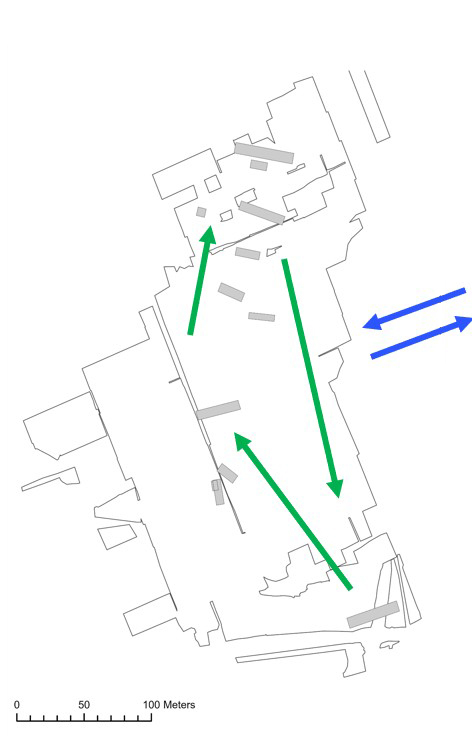
During the 4th and early 5th centuries, the settlements at Ede-Op den Berg and Ede-Veldhuizen each consisted of several contemporaneous longhouses, each with byres measuring around 10 m. The archaeological record suggests that at both settlements, approximately three byre‑houses were occupied per generation, providing enough stalling capacity (around 50 cattle) for a viable herd within the total local communities (Figure 4).
Because each settlement contained a full herd, their cattle economy was internally sustainable and did not require external economic relations for day-to-day operations. These settlements could have been relatively inward‑looking, bound by kinship, household life cycles, and ritual circulation of cattle and meat within the settlement (Figure 4; Green arrows). Hypothetically, the only external relations that were strictly necessary could have been limited to marriage and kinship relations (Figure 4; Blue arrows).
The 6th-Century Shift: Shorter Houses, Smaller Herds
The settlement structures at Ede-Uitvindersbuurt and Ede-Paasberg (6th century) reveal a different logic. Their houses, only about 20 m long, have byres of roughly 5 m (Figure 3). Such buildings could support only one-sixth of a viable herd. This means that each household in such a byrehouse would need to be in some sort of cattle community of six households to form a functioning, viable herd. Both excavations revealed only one byrehouse, but perhaps not the whole settlement was excavated at both sites, a typical feature of development-led archaeology. The archaeological record from the Central Netherlands, however, suggests that large contemporaneous groups of houses are rare in this period.
This means that the cattle economy of these communities must have been larger than in previous periods (6 households instead of 3). It is also likely that such a cattle community was divided across multiple settlements, since settlements with six or more contemporaneous houses are extremely rare for the period and region. Regular extra-communal cattle exchange, therefore, became structurally necessary from the sixth century onwards, hypothetically normalizing outward-oriented exchange networks in general.
Conclusion
Taken together, the evidence from Ede shows that the shift from large to markedly shorter byre‑houses reflects far more than a change in building tradition. It signals a broader reconfiguration of rural livelihood, in which agricultural practices, social relations, and inter‑settlement dependencies were fundamentally renegotiated. Continuity in occupation, therefore, should not be mistaken for continuity in the way communities sustained themselves; the sixth‑century farms operated according to a very different economic logic than their fifth‑century predecessors.
This also highlights a broader methodological issue. Different livelihood systems interact with the landscape in different ways, and pastoral communities—being less tied to high‑quality arable soils—may be underrepresented in our archaeological dataset. Predictive models (and policy decisions) that privilege soil suitability for crop production risk overlooking communities whose economic foundations lie elsewhere (Emaus, 2026).
Bibliography
Chang, C., & Koster, H. A. (1986). Beyond Bones : Toward an Archaeology of Pastoralism. Advances in Archaeological Method and Theory, 9, 97–148.
Dyson-Hudson, R., & Dyson-Hudson, N. (1970). The Food Production System of a Semi-Nomadic Society: The Karimojong, Uganda. In P. F. M. McLoughlin (Ed.), African Food Production Systems: Cases and Theory. Johns Hopkins Press.
Emaus, R. (2026). Marginal landscapes : a study of early medieval settlement preferences. Journal of Land Use Science, 21(1), 56–75. https://doi.org/10.1080/174742...;
Emaus, R. (2024). On byre-houses and husbandry: post-Roman settlement and landscape transformations in the Central Netherlands. Making Places, Making Lives. Landscape and Settlement in Coastal Wetlands, October, 185–202.
Evans-Pritchard, E. E. (1940). The Nuer: a description of the modes of livelihood and political institutions of a nilotic people. Oxford University Press.
Hamerow, H. (2002). Early Medieval Settlements: the Archaeology of Rural Communities in North-West Europe 400-900. Oxford University Press.
Hoven, E. (2014). Definitief Archeologisch onderzoek Ede Paasbergterrein, gemeente Ede. Synthegra bv.
Ingold, T. (1980). Hunters, Pastoralists and Ranchers. Cambridge University Press.
Olausson, M. (1999). Herding and stalling in Bronze Age Sweden. In C. Fabech & J. Ringtved (Eds.), Settlement and landscape. Proceedings of a conference in Arhus, Denmark, May 4-7 1998 (Arhus 1999).
Taayke, E., Peen, C., van der Harst - van Domburg, M., & Vos, W. (2012). Ede vol erven: Germaanse bewoning op de rand van een wereldrijk. Hazenberg Archeologie.
ter Wal, A., & Witte, N. (2013). Ede Uitvindersbuurt fase III: een opgraving van een laat-Romeins grafveld en bewoningssporen uit de ijzertijd tot vroege middeleeuwen. BAAC bv.
Waterbolk, H. T. (1975). Evidence of cattle stalling in excavated pre- and protohistoric houses. In A. t. Clason (Ed.), Archaeozoological Studies. Papers of the archaeozoological conference 1974, held at the Biologisch- Archeologisch Instituut of the State University of Groningen (Amsterdam 1975).
Zimmermann, W. H. (1999). Why was cattle-stalling introduced in prehistory? The significance of byre and stable and of outwintering. In C. Fabech & J. Ringtved (Eds.), Settlement and Landscape. Proceedings of a conference in Arhus, Denmark, May 4-7 1998 (Arhus 1999).
© Roeland Emaus and Leiden Medievalists Blog, 2026. Unauthorised use and/or duplication of this material without express and written permission from this site’s author and/or owner is strictly prohibited. Excerpts and links may be used, provided that full and clear credit is given to Roeland Emaus and Leiden Medievalists Blog with appropriate and specific direction to the original content.