

Abracadabra? The Graffiti on the Haarlem Broodbank
A close-up look at the intriguing medieval graffiti on the Haarlem Broodbank
The study of old graffiti is a relatively new field in art history. Unfortunately, in the Netherlands there is not much of it left. While the rather rude graffiti of the street has survived only in collections like Hieronymus Sweerts’ Koddige en ernstige opschriften [Funny and Serious Inscriptions] of 1682, there is quite a lot of prison graffiti, while the graffiti inside Dutch churches, which was generally of a more reflective nature, was lost when church walls were stripped of their layers of plaster because of the early-20th-century liking for ‘schoonwerk’ - unplastered walls. This is why in Dutch churches graffiti have mainly survived on church furniture. The much-restored Broodbank in Haarlem’s medieval St Bavo Church (see the previous blog of 12 June 2026) is still covered in it.
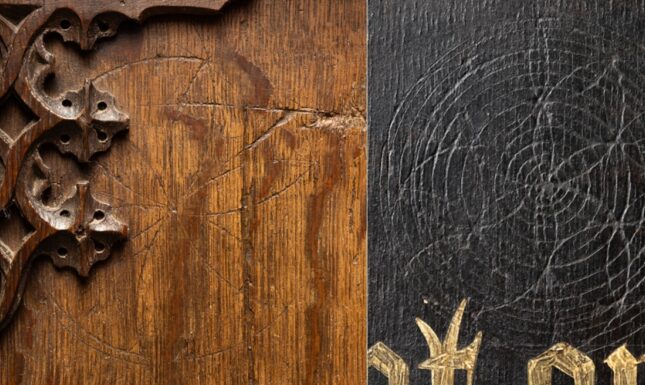
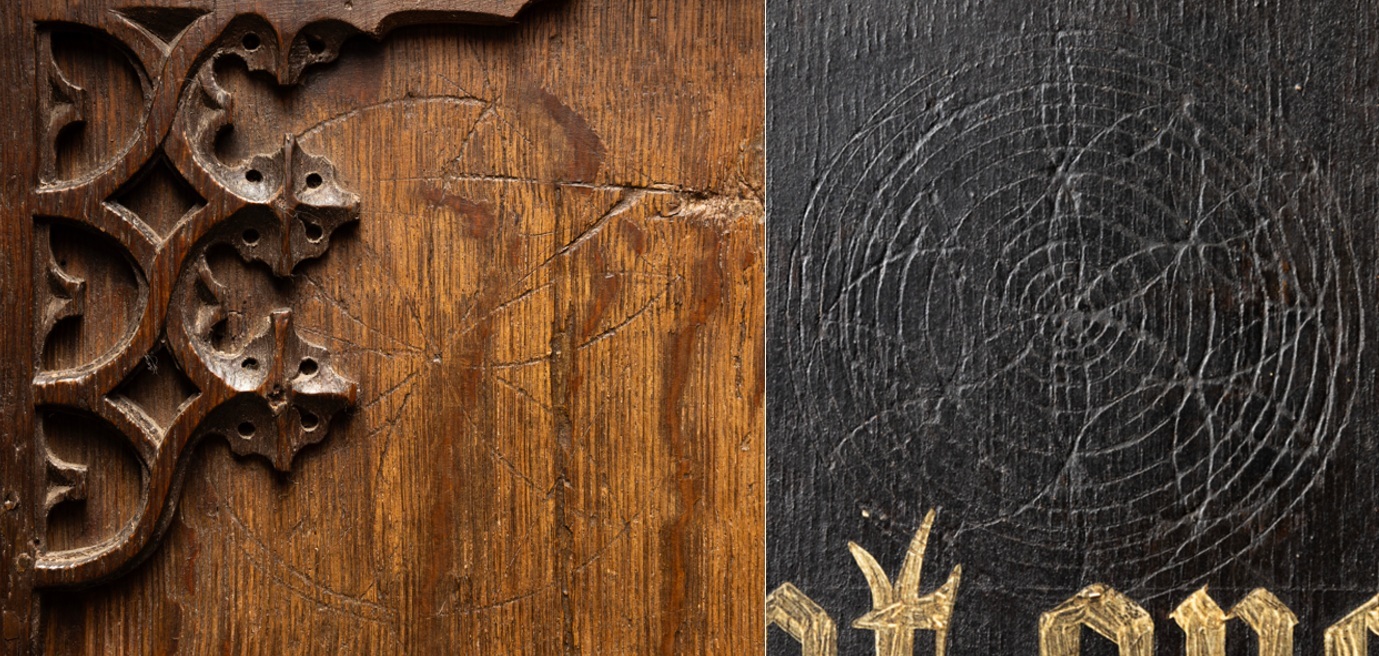
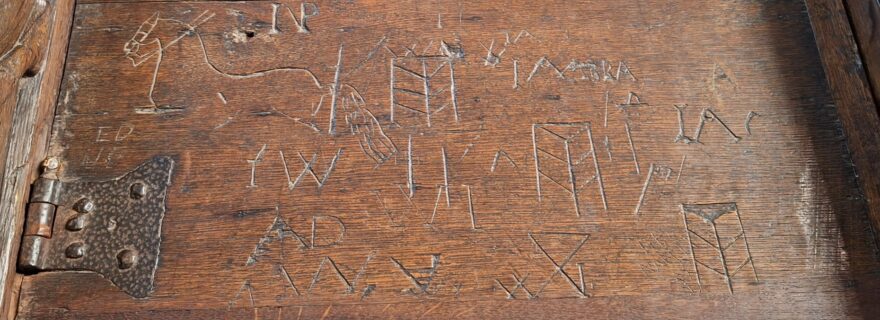
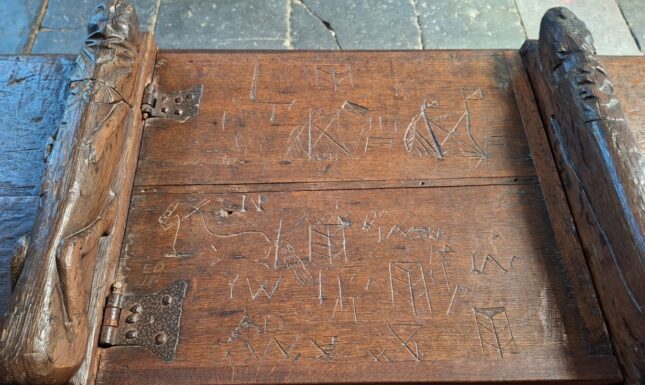
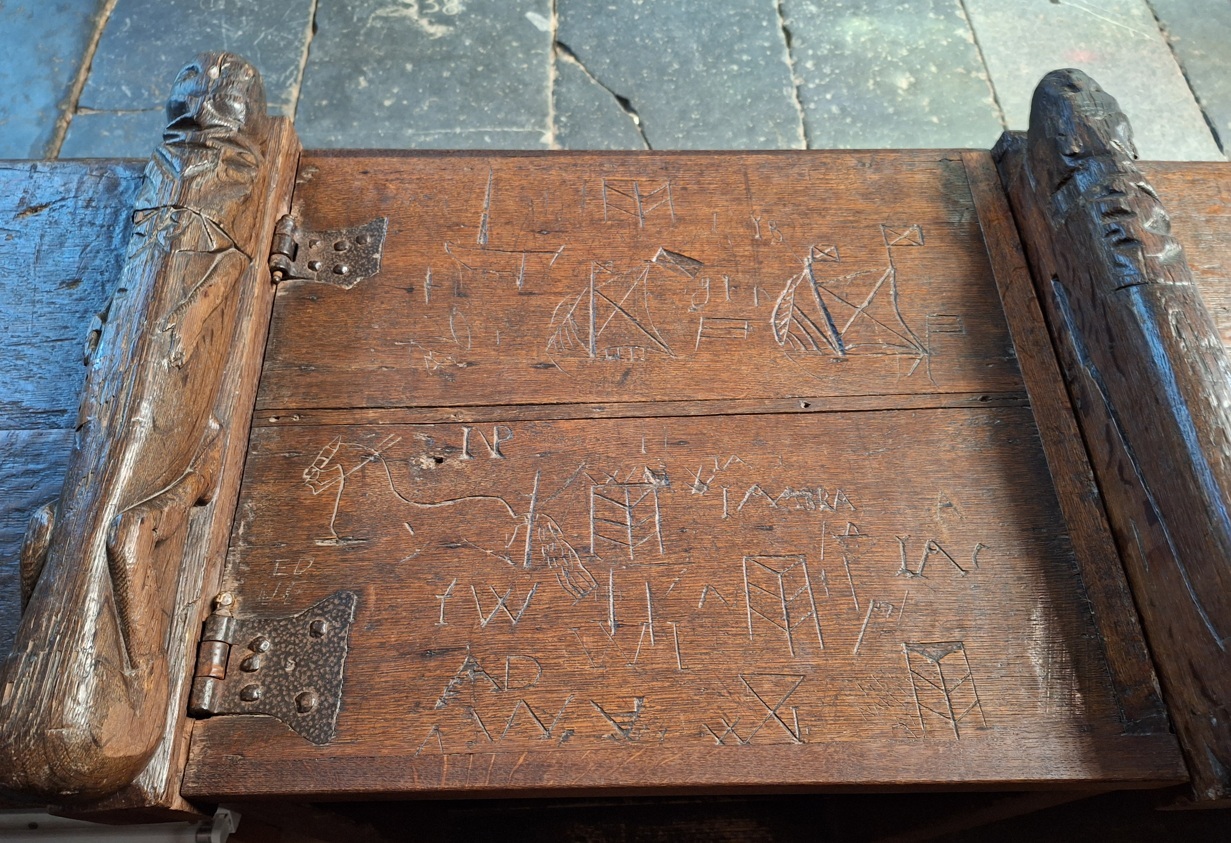
The oldest graffiti on the Broodbank are probably those on the panels above the seats on the back of the bench. Here there are many compass-drawn circles, clusters of circles and so-called daisy wheels (plate 1), but in addition there are also initials, gallows, what look like scenes of execution, a church tower with a large rosette carved on to it, a naked but bold woman, ship forms, and more. On the front work bench most of the graffiti is concentrated on the folding hatch over the entrance (which did not originally belong to the bench) that is covered in initials, what look like tree-legged stools, a horse without a rider, and several ships intended for shallow waters, some more complete than others, and with St Andrew’s crosses in their sails (plate 2). On both the front and the rear there are also some dates ranging from 1587 to 1627. These graffiti reflect shocking events like the battle on the Haarlemmermeer, the siege and capture of the city by Spanish troops and the ensuing executions, the retaking of Haarlem by Protestant forces, and on a more personal level, graffiti related to adultery, possible witchcraft, and pleas for divine or otherworldly assistance.
Graffiti are often thought to have been the work of bored choir boys or schoolkids. On a painting by Emmanuel de Witte (c. 1650) of the interior of the Oude Kerk in Delft (New York, Metropolitan Museum of Art), two boys are shown drawing on one of the nave piers. As the adjacent pier on the painting is being sprayed by a dog, the boys are obviously committing an act of vandalism. Indeed, the Dutch proverb “Fools and nitwits write their names on doors (or walls) and windows,” that is first recorded in the 17th century implies that the making of graffiti was considered something ‘not done’. The Westerkerk in Enkhuizen and the church of Schermerhorn still house large ordinance boards listing activities deemed inadmissible in and around the church that were subject to a fine. In Enkhuizen “writing with chalk, charcoal or other material on the walls and columns, as well as carving into pews and other woodwork” scores relatively high in the list.
Before the 16th century, however, the attitude towards graffiti was ambivalent. Graffiti was sometimes considered a pest, but in other cases people were granted permission to make a graffito, and sometimes what we now call graffiti appear to have been connected to pre-Reformation cult practices. It is these older graffiti with which this blog is concerned.
Circles and daisy wheels
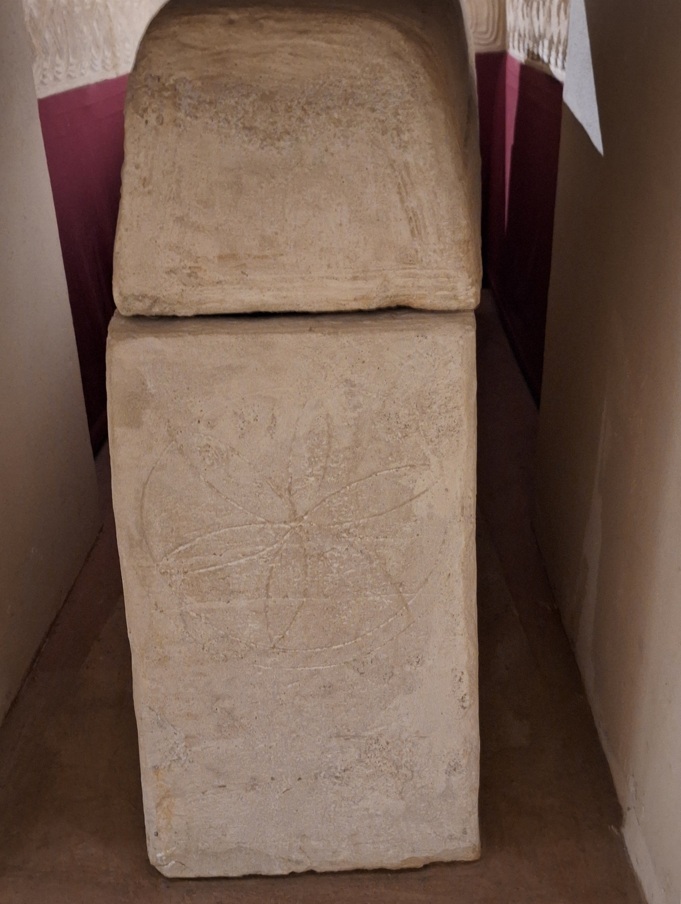
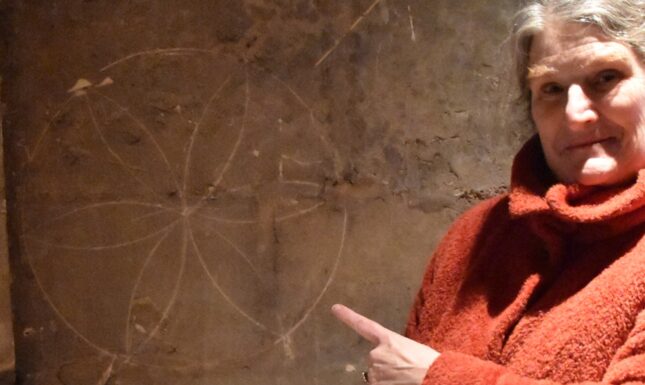
The many circles, intertwined circles and daisy wheels appear to have been an approved form of graffiti, and they probably largely predate the late 16th-century Reformation. This type of incised drawing is one of the commonest forms of graffiti throughout western Europe in both ecclesiastical and secular settings, in prisons, great halls, and in domestic buildings. Often, they are described as signs to ward off evil, and in a sense, this is not entirely incorrect. However, warding off evil with amulets, incantations, magic circles, and other means was a practice that was frowned upon and even forbidden by the Church that wanted to keep the monopoly on warding off danger in its own hands, so I prefer to think of these circle graffiti as ecclesiastical blessings performed by the bishop, as signs that an object or building was placed under God’s protection. Not only are the circle and the compass age-old symbols of God as creator, daisy wheels and circles can be found from an early date on tombs, as on the stone sarcophagus of the bishop and missionary Willibrord in Echternach (plate 3).
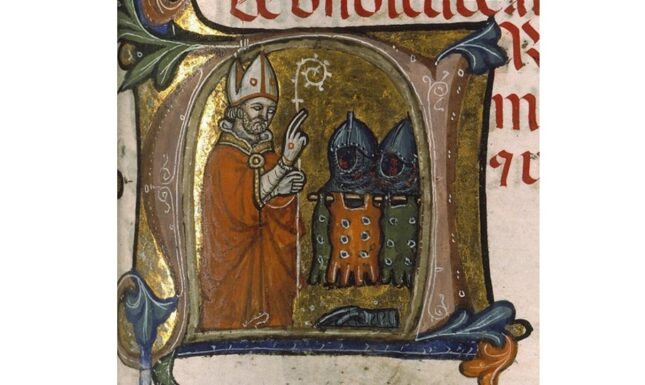
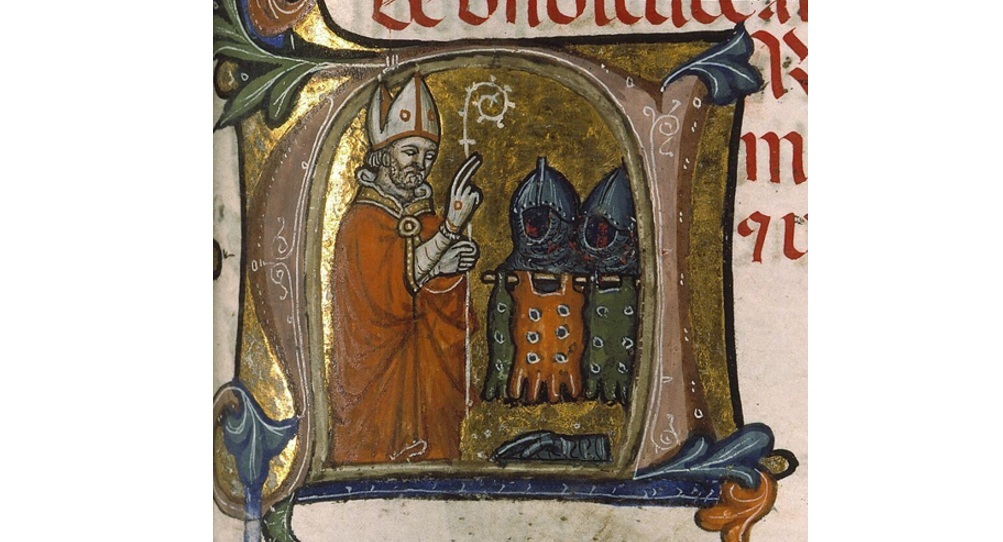
Consecration crosses, commemorating the consecration of a church by the bishop, are well known in the literature, but the medieval practice of blessing was far more extensive than that. In a 14th-century manuscript of William Durandus’ Pontificale the bishop is repeatedly shown blessing objects that range from a diptych, a statue of the Virgin Mary, to a well, tableware, and a knight’s armour (plate 4). It is quite possible that objects were marked with circles and/or daisy wheels to show these were blessed objects. Thus, we find clusters of circles on the rear wall of a holy water basin in the church of Zaltbommel, a place where it is unfeasible that evil would have been warded off by magical means. These circles were sanctioned by the church. Inside the church tower of Our Lady of Tongres, that doubled as a civic tower, there is a whole series of circles and daisy wheels, placed in or near all the main apertures, some of which are so large (c. 75 cm in diameter) that it is clear that this was not done by an ordinary churchgoer, but by a (master-)mason, as only people within the building trade would have had compasses that large, which implies that these circles are part of an unauthorized benediction programme (plate 5). The same holds true elsewhere. It takes expertise to make perfect compass-drawn circles, circle clusters and daisy wheels into stone walls and the hard oak wood of medieval furniture, and even a small pair of compasses is not something one usually carries into church. As for the Broodbank, the circle graffiti on the back of the bench are probably related to donations benefitting the poor having been made to the masters of the Holy Spirit.
Initials and letters
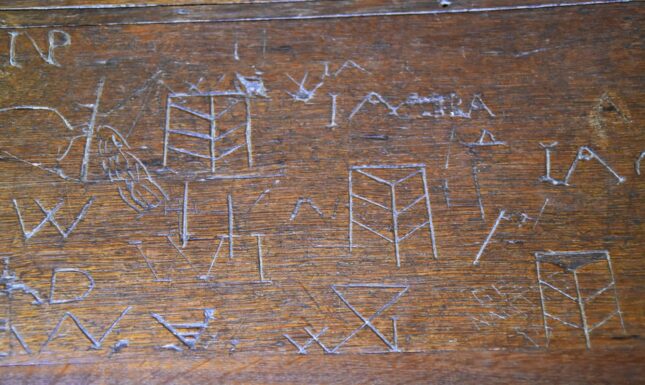
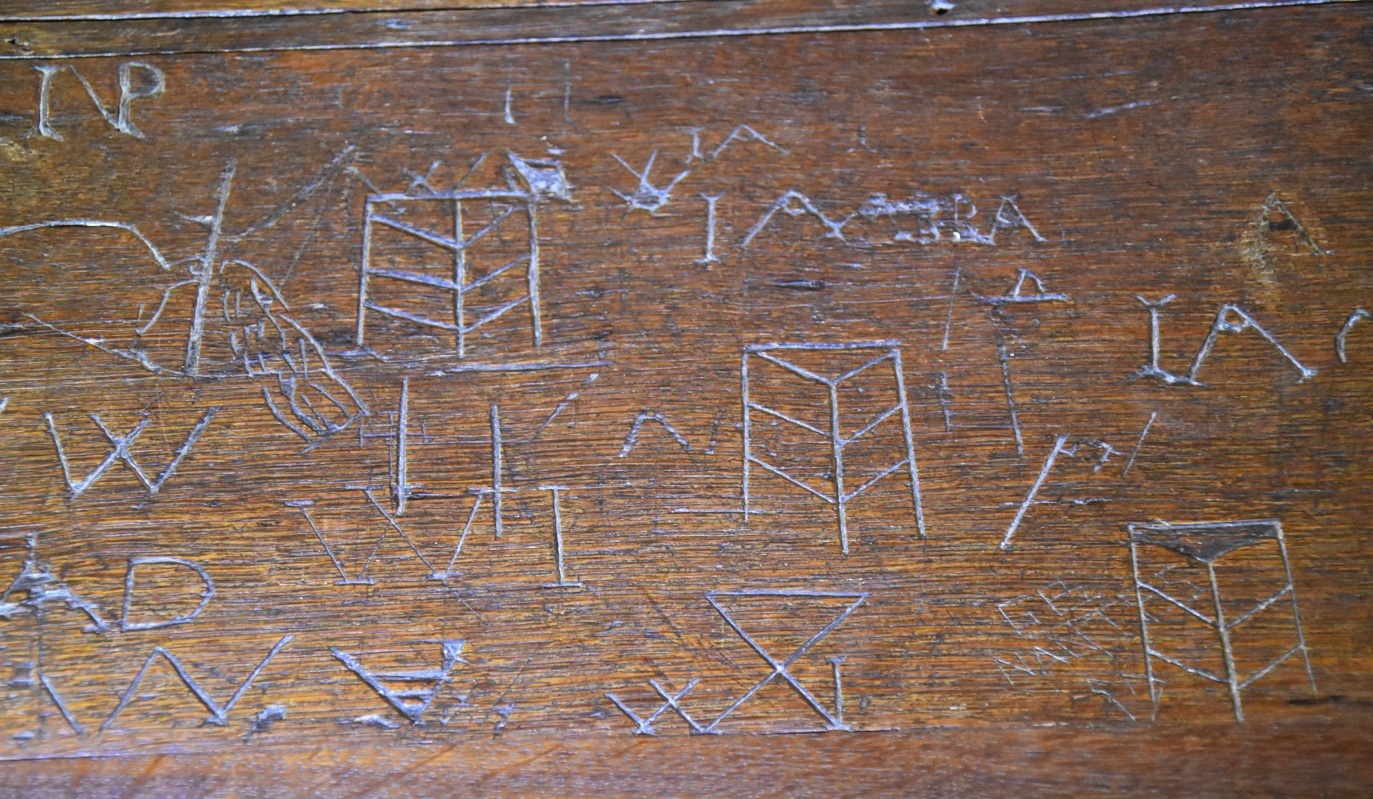
The Broodbank has many letters carved into it. Looking at the frequency with which these letters are distributed across the Broodbank, it is striking that some letters and letter combinations occur more frequently than others, particularly the A, A I, and W I (plate 6). The predominance of certain letters or letter combinations is a common phenomenon in old graffiti, showing that not all the initials used are personal initials. The often-recurring M is considered an abbreviation of the name Mary. The W, written as two V’s, is an abbreviation of Virgo Virginum, Virgin of Virgins, but can also stand for ‘Vir Venerabilis’, venerable man. The R was often combined with the M and is then the abbreviation of Regina (queen) Maria. The P can stand for Paternoster, Our Father. Such initials are like prayers carved into wood. After the Reformation, the letters VV remained in use, but were interpreted differently. VV now became ‘Verbum Venerabilis’, the venerable word, or ‘Vero Verbum’, the true word. MVV changed from ‘Maria Virgo Virginum’ to ‘Martyrem Vero Verbum’, martyr for the true word. The ambiguity may even have been a precautionary measure. VV I can be resolved as ‘Vero Verbum Ihesu’ (the true word of Christ) and I VV as ‘Ihesu Verum verbum’, Protestant versions of a long-standing abbreviation.
The letter A: Alpha, Agla, Abracadra, Abra
The letter A also appears frequently on the Broodbank, both individually and in combination with the M and I. The combinations feature primarily on the folding hatch and workbench, while the individual A’s are found on the back panels.
The A was certainly more than just a letter. As the first letter of Alpha, the A was a symbol of the beginning and applied to both God and Christ (Revelation 1:8, 22:6, and 22:13), especially when that A was combined with the Omega (the end). However, the A was also the first letter of ‘agla’, an abbreviation of the Hebrew ‘atta gibbor leolam adonai’, meaning ‘Thou art mighty forever, Lord’, a word that appears regularly on amulets from the 12th century onwards, or of ‘adonai’. The letters I and A on the Haarlem Broodbank fit this picture and could therefore stand for something like ‘Ihesus Adonai’, Jesus Lord or Jesus God, while the combination A I could be an abbreviation of ‘Adonai’. In both options, the A signifies Christ or God. The A could also be an abbreviated form of ‘abracadabra’, a word said to derive from the Hebrew ‘Ha-brachab-Dabara’ (name of the blessed). Abra on its own (which occurs on the Broodbank once) is the same as the Hebrew ‘arba’, which stands for the number four and the tetragrammaton, i.e. the four letters of God’s name: yhwh. Again, abra denotes the Deity that was omnipresent to resist evil.
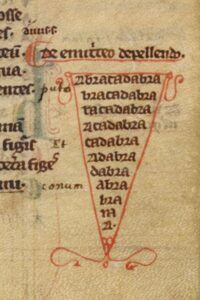
Interestingly, the physician Quintus Serenus Sammonicus (†212), the teacher of the brothers (and later Roman emperors) Geta and Caracalla, prescribed the making of an amulet as a remedy for malaria in a didactic poem in his Liber Medicinalis. This amulet consisted of writing the word abracadabra on a small piece of paper and repeating that word on every subsequent line, using one letter less each time, until only the A remained and the text thus written out resembled a triangle. This amulet was to be worn around the neck for nine days as a remedy for fever. Subsequently, it was to be removed and thrown into water flowing towards the east. That the Liber Medicinalis and the abracadabra triangle were still in use in medieval times is shown by two volumes in Canterbury’s Cathedral library containing the abracadabra triangle against malaria (plate 7). The word abracadabra, as well as variants and abbreviations thereof also occur on a pectoral cross found in 1910 in an early medieval tomb in the cemetery of the cathedral in Lausanne. It was made from a thin sheet of silver sometime between the 6th and 8th centuries. The frequent repetition of the mystical word was intended to increase the effectiveness of the amulet. All in all, the letters A and certainly the word ‘abra’ on the Broodbank are likely to have been intended to invoke God’s blessing and protection.
Graffiti circles, circle clusters and daisy wheels disappeared in the wake of the Reformation as the reformed religion had no place for such ‘superstitions’. This was a gradual process, as graffiti continued to be made inside the churches, albeit that the meaning of some of the abbreviations changed and that the abbreviated prayer formulas turned into personal initials. By the late 16th century, to put an end to this age-old practice, the making of a graffito came to be associated with bad behaviour, a minor offense that could be fined, and then, in later centuries, it even grew into an expression of the perpetrator’s criminal mind.
For a more sustained argument concerning the above, a full bibliography, and for the later graffiti on the Broodbank and in the church, see: E. den Hartog, Tekens aan de wand. De oude graffiti in de Haarlemse Grote of St.-Bavokerk in context (Haarlem, Kantoor Verschoor boekmakers 2025)