The so-called Broodbank: A complicated piece of furniture in the St Bavo Church in Haarlem

The St Bavo Church in Haarlem houses a remarkable piece of furniture known as the Broodbank, i.e. a bench from where alms were handed out to the poor. This blog will highlight its complicated history, while the next blog (end of June) will discuss the Broodbank’s medieval and early modern graffiti.
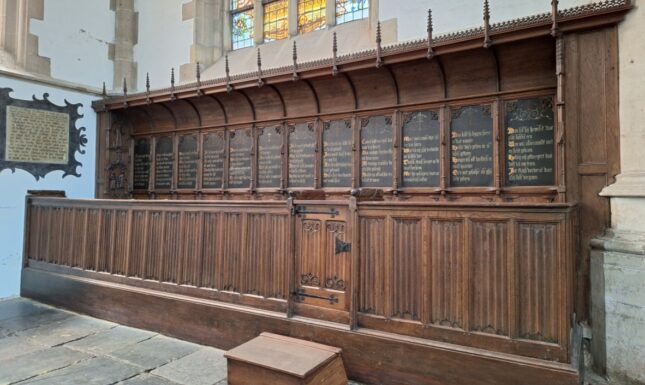
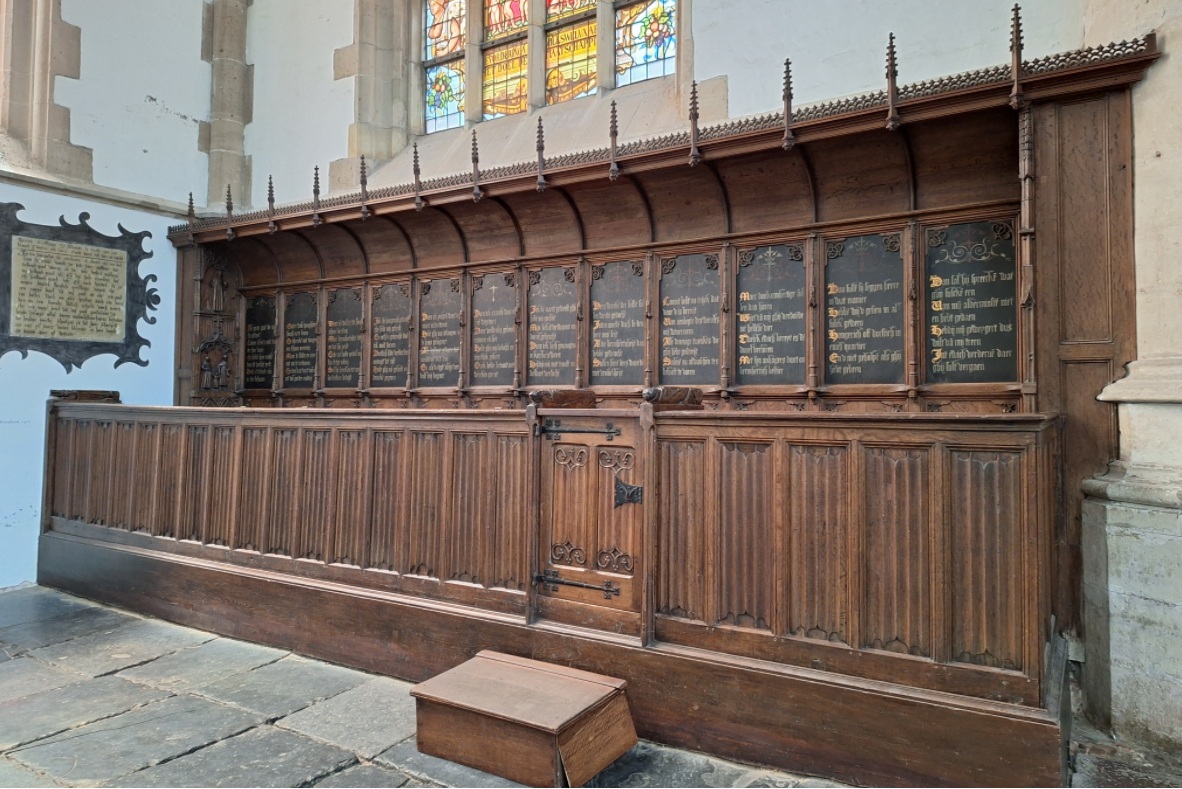
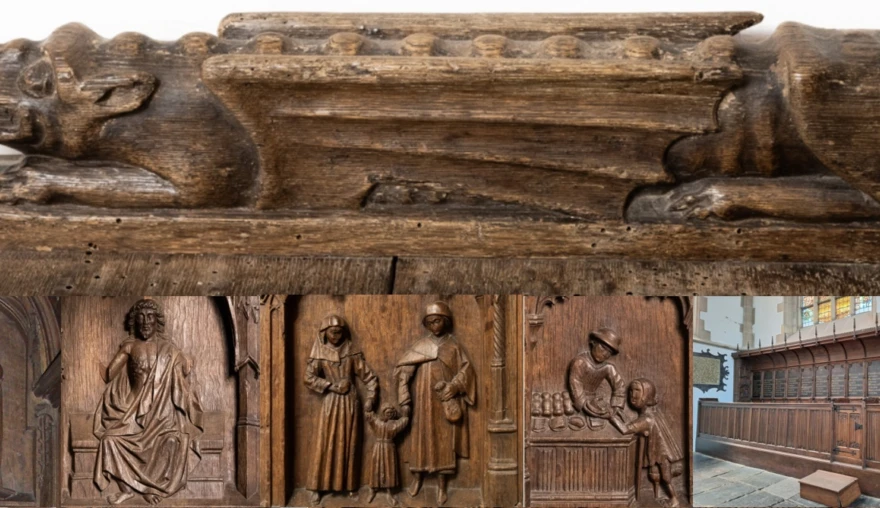
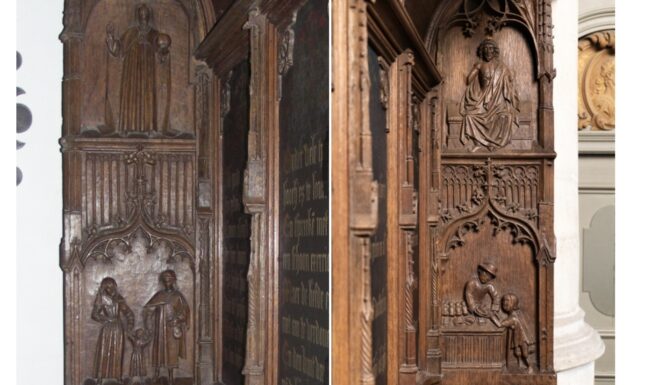
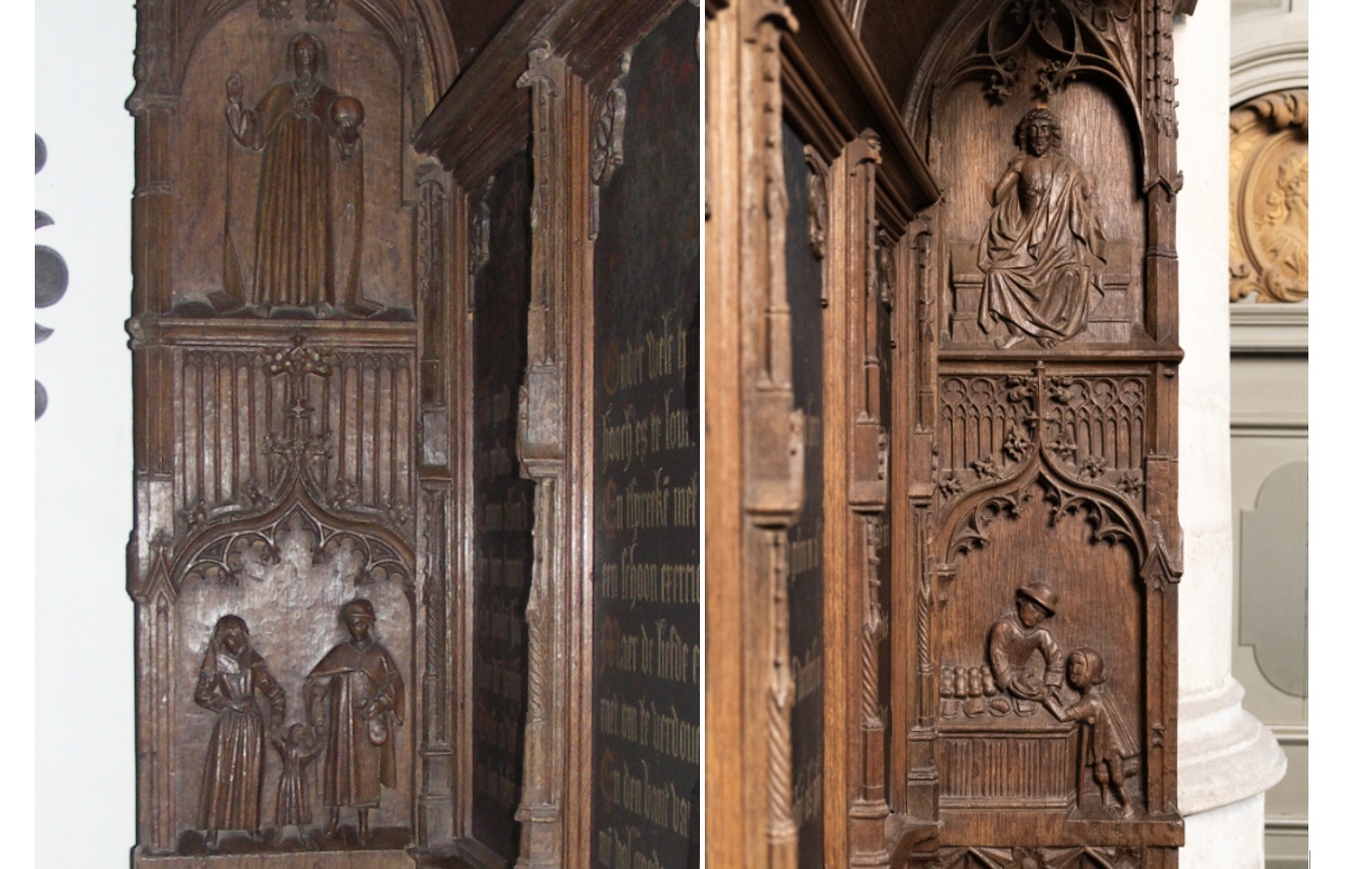
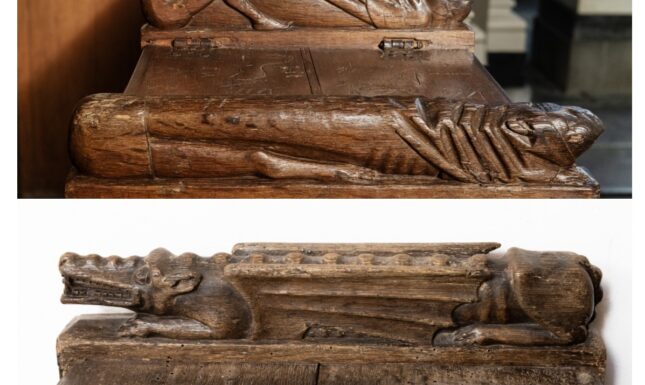
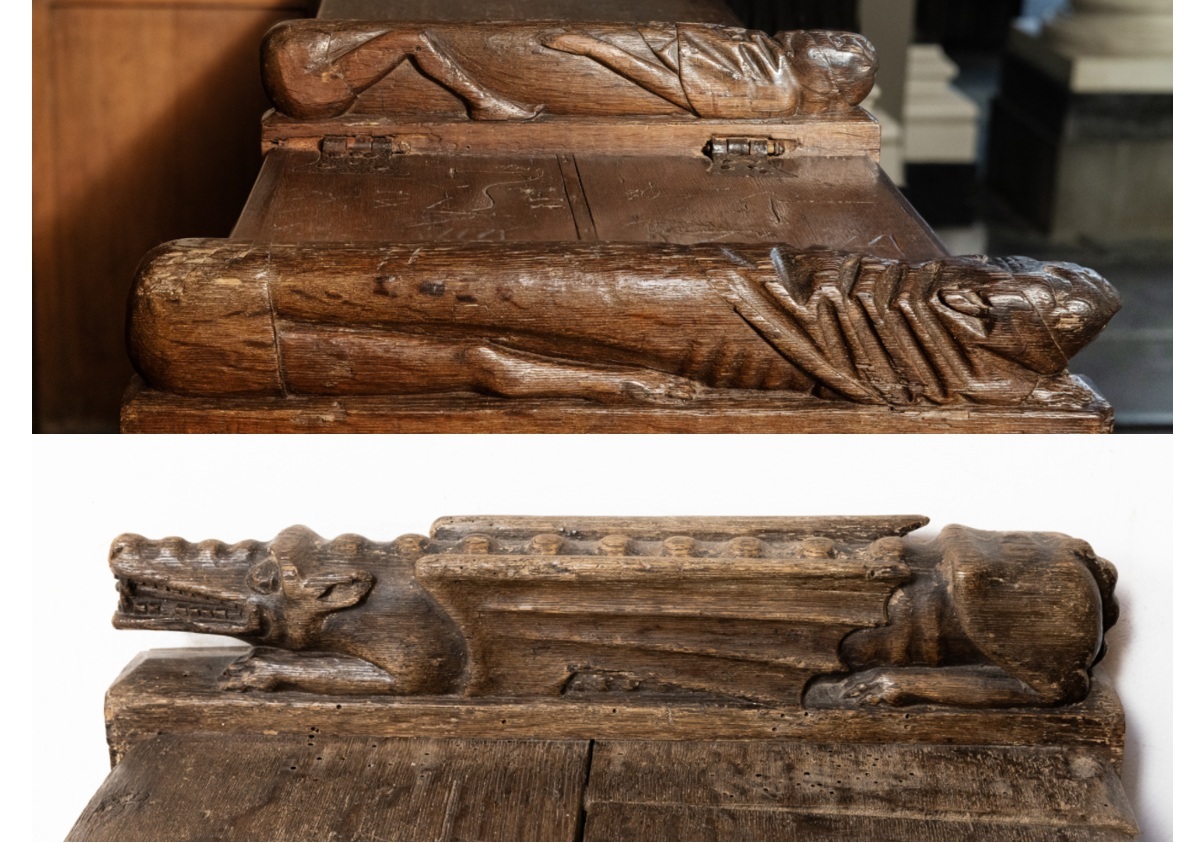
Dutch medieval furniture has been very much understudied. Often, the dates given to the prime examples since the nineteenth century have gone unquestioned. A case in point is the alms bench or ‘Broodbank’, as it is referred to in modern parlance, while older sources refer to it as the ‘Heilig Geest-stoel’, i.e. the pew of the Masters of the Holy Spirit, that is housed in the St Bavo Church on the market square in Haarlem. This voluminous piece of furniture consists of twelve seats under a pinnacled canopy and has two richly carved bench-ends (plate 1). On the left one, the image of a mother and father supporting their child is surmounted by the figure of Christ the Saviour; on the right, a man is shown distributing bread and bacon to a disabled person on crutches, with the figure of Christ above, displaying his side wound (plate 2). Another interesting feature of the Broodbank is that parts of its surface are covered in graffiti.
The Broodbank is generally dated c. 1475-80 because the southwest corner of the nave, where the bench is presently located, was completed around this time. Although it was heavily restored in the 19th and 20th centuries and fitted out with its current canopy in 1902, the Broodbank is thought to still reflect its original 15th-century appearance. Judging from the depiction of the distribution to a disabled person on the right-hand side bench-end and the three stone plaques commemorating endowments for alms distributions that are set into the wall beside the Broodbank, it is believed that the Masters of the Holy Spirit distributed bread and bacon to the poor from the said bench, a ‘ tradition’ that has been revived in a modernized form in recent years. A closer inspection of the Broodbank shows that all these assumptions are incorrect. The Broodbank is a complicated structure, and its history not a straightforward one. What is it that we are looking at?
The Broodbank’s composite structure
Even a cursory examination reveals striking incongruities. For one, the twelve rear text panels relate to six works of mercy and therefore reflect Protestant doctrine, as the Protestants recognize six works of mercy as against the Catholic seven. Beneath these back panels are twelve seats. The bench’s front is wider than the rear, and the door is asymmetrically placed, with sixteen panels to the left and five to the right. The style of the door’s two panels differs from that of the others. The rear section of the Broodbank has also been supplemented with later additions on the left and right to make it fit its current location, and the bench was placed on a podium that is so high that one can only hoist oneself into the pew with difficulty. Another anomaly is the presence of three strangely elongated figures that lie atop the bench. Two are placed beside the doorway and one against the southern aisle wall. Not only does one of the figures have a truncated side, but the figures are also carved in diverging styles (the winged dragon against the south wall is younger than the other two figures that are of a late 14th- or 15th-century date) (plate 3). This suggests that these figures came from elsewhere and were reused.
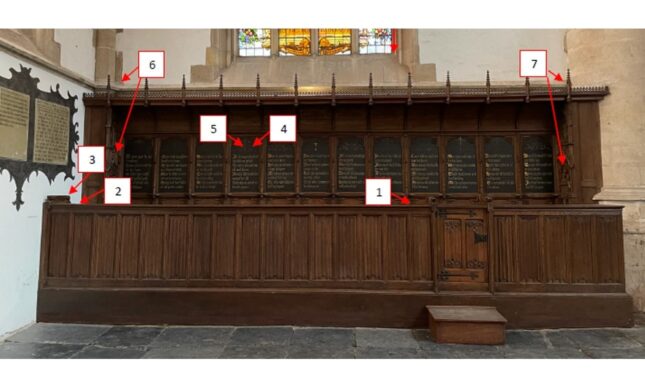
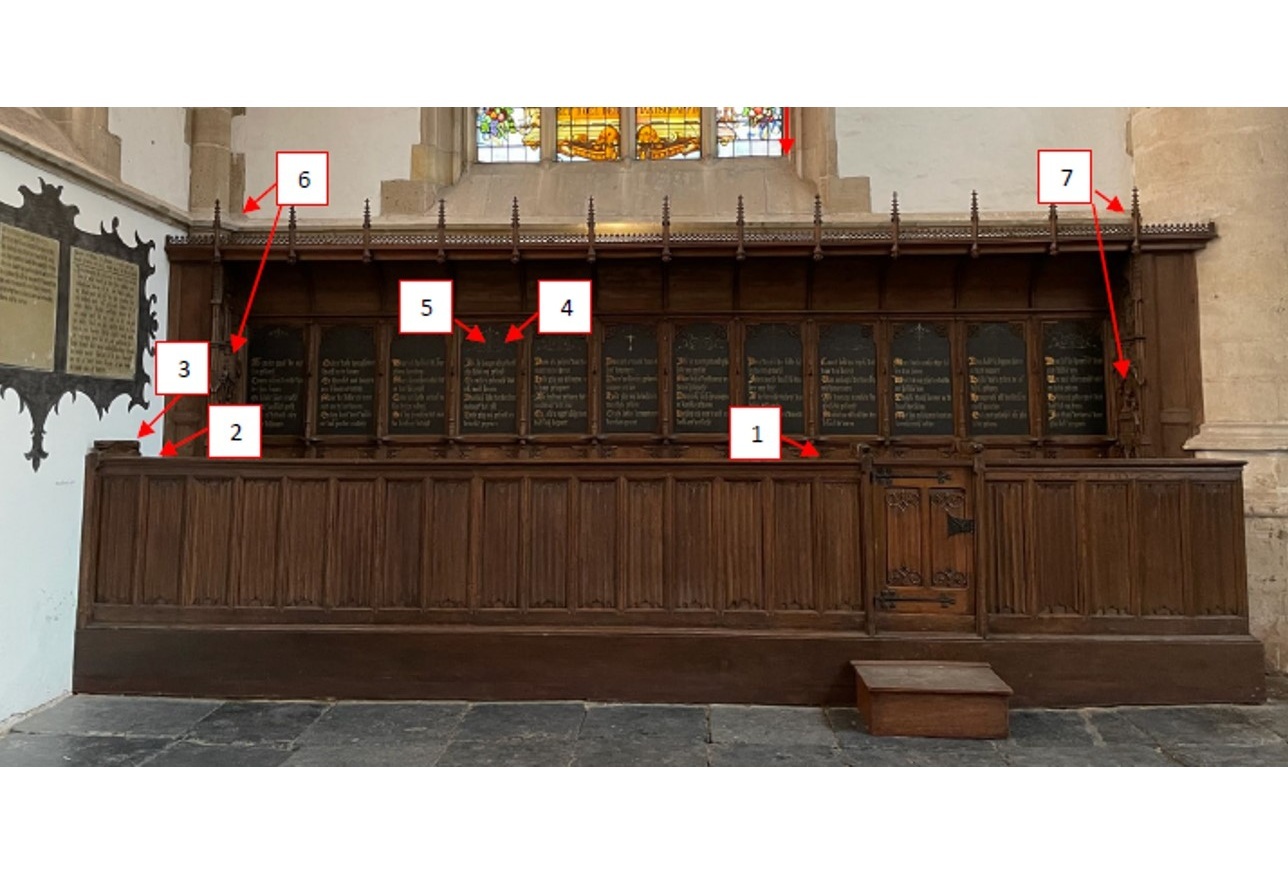
The idea that the Broodbank constitutes an assembly of different parts that did not originally belong together was confirmed in 2023, when seven parts of the bench were sampled by Marta Domínguez-Delmás and dendrochronologically dated. The lack of sapwood meant that it was only possible to approximate the felling date of the trees from which the various parts were made. Block 1 dates from after 1434, block 2 after 1449. Number 3 (the dragon) is made of wood that was felled after 1445. Numbers 4 and 5 are the two boards from which the fourth text panel from the left was made. One plank postdates 1417, the other 1463. Numbers 6 and 7, the two bench-ends, were made of wood from a tree felled after 1425 (plate 4).
The Mysterious Origins of the Broodbank
Another problem is that the Broodbank as we know it is not traceable before the 18th century. It does not feature in the work of Pieter Saenredam (1597-1665), who made drawings and paintings of the church from all angles, and it is missing from the plan in Samuel Ampzing’s 1628 Beschreyvinge ende lof der stad Haerlem, that shows how the church was furnished in Catholic times. The burial books of the church show that there were graves where the Broodbank is now placed until the 1630s, when they were cleared. By 1670, however, the Broodbank was in its present position. The oldest depiction of the bench, on a 1762 engraving, shows it with a classicistic entablature. So where was the Broodbank before and what form did it take?
The graffiti on the bench shows that in the 16th and 17th centuries at least, the Broodbank was accessible. The question is whether this holds true for all parts of the present bench. In his Memoriaelbouck Willem Janszoon Verwer, a Catholic city administrator and church master, mentions how, on 4 December 1572, a mob attacked all statues, mass vestments and other items in the St Bavo Church. So much was looted that, according to Verwer, only the baptismal font, three organs, and the choir stalls remained. A few months later, the church suffered another attack during which the altars were demolished, and on 29 May 1578, the church was again plundered. Wat is more, from 1578 onwards, the Reformed Haarlem church council had the church purged of all its Catholic imagery. In 1582, the statues above the church portal, the depiction of the Holy Trinity in the large west window and another window containing a depiction of the Trinity were removed. In 1622, statues of Mary and St Bavo on the exterior of the church caused offence, as did the many “public idols” present elsewhere in the city. A statue of St Bavo was taken down in 1623, but the statues of Mary and St Bavo that adorned the facades of the transept arms, because of their high location, lasted until the 19th century (Mary) and late 20th century (Bavo), when they were taken inside to prevent further weathering. In 1642, a depiction of Mary was removed from a glass window in the church, and in 1648, this happened to the call to “pray for the soul” on graves and the chalices depicted on priests' tomb stones. Paintings of St Bavo and St Martin were whitewashed over and even the small images of saints on the keystones of the vault were thickly covered in lime.
And all this, the figures of Christ the Saviour and the Judgmental Christ on the Broodbank bench-ends survived almost intact? They show damage, but this is negligeable. It may thus be assumed that the bench-ends with the two Christ figures were not inside the church when all this was going on. They could of course have been temporarily removed and stored away by the Masters of the Holy Spirit. More likely they came from the Heilig Geesthuis where the Masters of Holy Spirit had their own chapel and pew, for which Geertgen van St Jans (1455/65-1485/95) painted the seven works of mercy. The Heilig-Geesthuis retained its function until 1765 and was demolished in 1768. Apparently, during or after its dissolution, the three stone plaques now bricked into the wall near the Broodbank were moved to the St Bavo Church (the endowments mentioned have little to do with St Bavo Church). It is possible that some pieces of furniture were also moved to here.
The bench
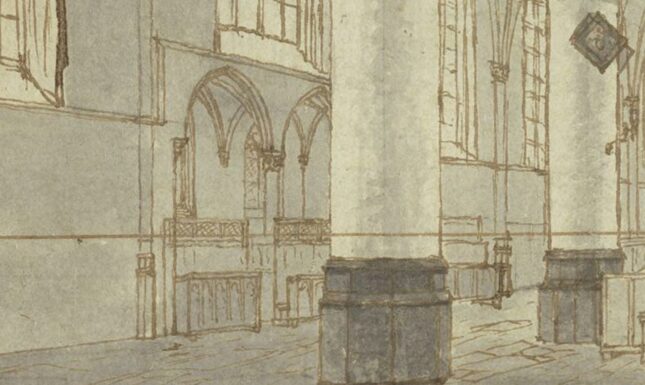
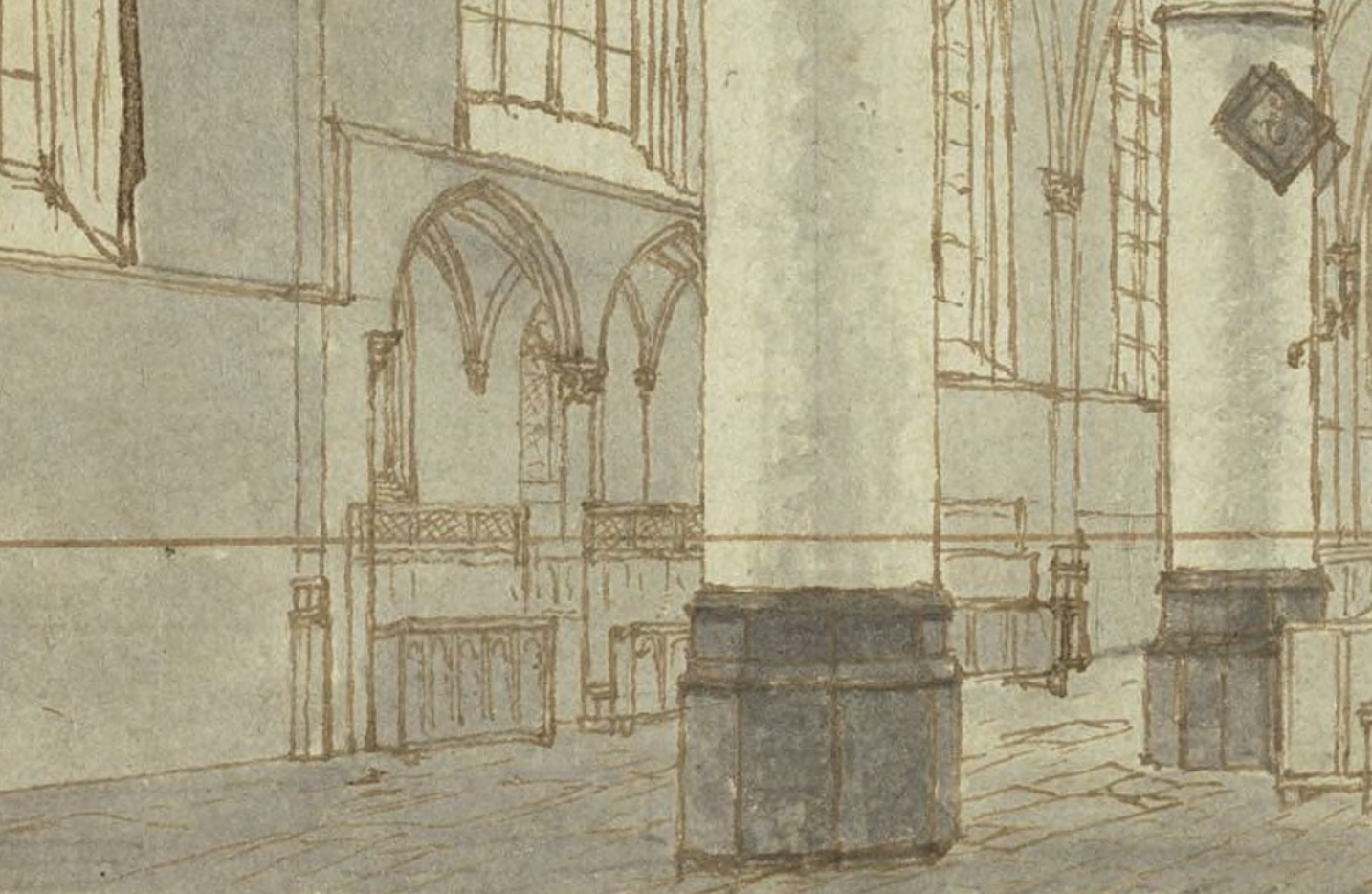
But to what corpus were the bench-ends added? The only piece of furniture shown on interior views of the St Bavo Church that looks remotely like the Broodbank is a medieval-looking bench in front of the so-called Hondeslagerskapel shown in a 1627 drawing by Saenredam (plate 8). This bench has a back side crowned with a stack of panels, and front paneling with (presumably) a central passageway. As there are five panels decorated with pointed arches to be seen to the left of the passage presumably there were five on the other side also (two can be seen, the rest disappears behind a pillar). This implies there were twelve seats at the rear. The left part of the bench has no bench-end. Although the detailing differs, the size of the bench in front of the Hondeslagerskapel resembles that of the Broodbank. On an engraving that Jan van der Velde made after Saenredams drawing, the bench is even shown with panels rather like those of the Broodbank. It is thus possible that it was this pew that was gradually transformed into today’s Broodbank.
Its function
Lastly, there is the problem of the bench’s function. Whoever sits down in it cannot, even if so disposed, hand out anything. The only way to hand out alms is by standing up. But with twelve people in the pew, there is hardly any space for storage. Illustrations of alms distributions moreover tend to show one to four people distributing alms, not twelve, and they never appear to be doing this inside a church, but either outdoors or from a room built against the church walls where the items to be distributed were stored. Indeed, such a place is indicated on the 1628 plan in Ampzing’s book as a “little room where at certain times the poor people received bread, dairy products, etcetera, from this Table of the Holy Spirit, from the hands of the fathers of the orphanage”. This suggests that food was distributed to the poor through a window adjacent to the street and not from a fancy twelve-seater alms bench.
To conclude, the alleged Broodbank is clearly a pastiche made up of different medieval parts. It also appears to have been a high-status pew in which the Masters of the Holy Spirit, who had their own chapel which they presumably used on weekdays, were seated during Sunday Mass and where they may have received gifts and donations for the poor. That the bench was not located inside the choir enclosure is evidenced by the many graffiti. The most probable original location for the Heilig Geest pew is somewhere near the main parish altar. This all shows that where medieval furniture is concerned, there is still much to be gained from a thorough analysis of even the best-known pieces, in combination with a critique of the documentary sources and dendrochronological analysis.
For a more detailed description of the Broodbank and its graffiti see, E. den Hartog, Tekens aan de wand. De oude graffiti in de Haarlemse Grote of St.-Bavokerk in context (Haarlem, Kantoor Verschoor boekmakers 2025)