

Feathered Philosophers and Their Brilliant Beaks: Talkings Parrots in Medieval Literature
When we consider the most intelligent animals outside of the human race nowadays, frequent suggestions include dolphins, octopuses, ravens and pigs. Looking at various literary works, in the Middle Ages the obvious answer may have been the polyglot parrot.
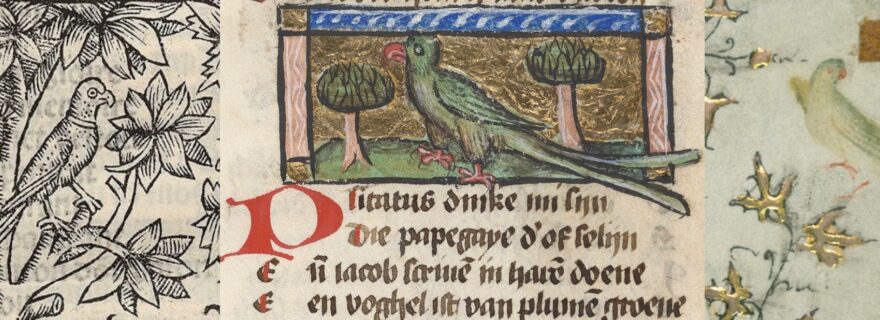
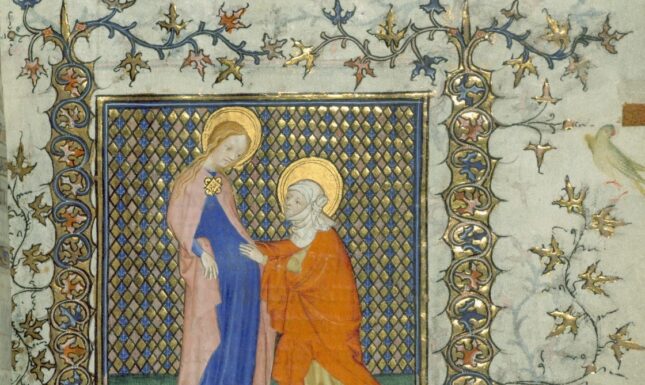
Despite initially heralding from far off lands, parrots were frequently found in Western medieval life, culture and art. Parrots were kept as exotic pets in Western Europe since Classical antiquity, but also appeared as beloved visual motifs of marginal decorations in illuminated manuscripts and as narrative characters in medieval literature [Fig. 1].
What made this bird stand out from all other feathers of the flock was firstly its colourful appearance, but most of all its ability to reproduce human language. This exceptional ability is often emphasized in medieval bestiaries and encyclopaedias, for example in Jacob van Maerlant’s Der nature bloeme (ca. 1270), a Middle Dutch adaptation of the Liber de natura rerum by Thomas of Cantimpré (book III, ll. 3265-3273) [Fig. 2]:
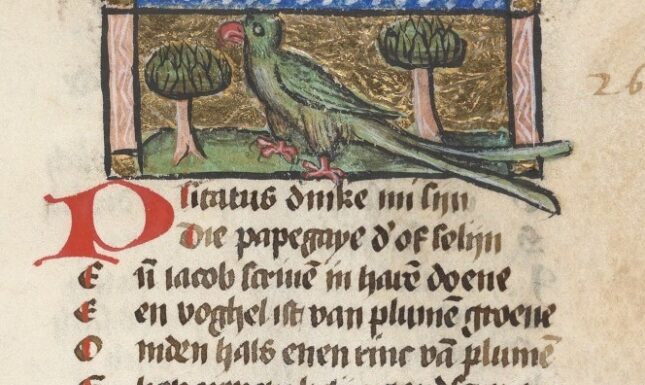
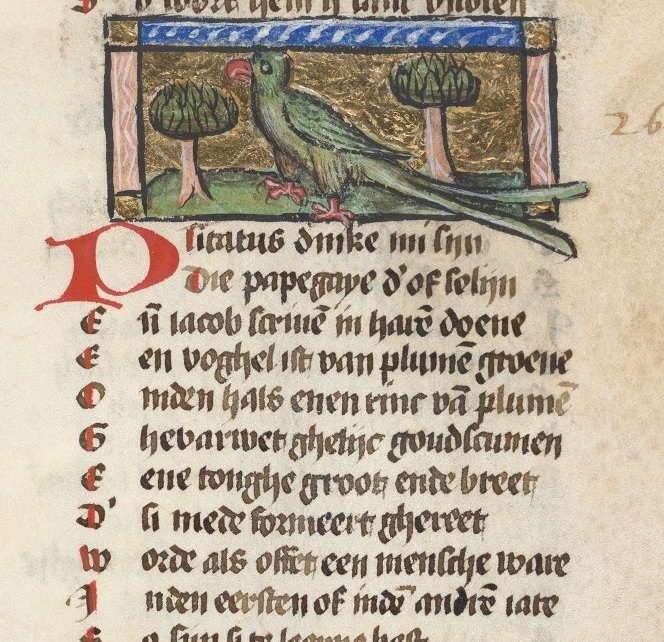
Pitacus dinct mi sijn
Die papegay, daer of Solijn
Ende Jacob scriven in haren doene.
Een voghel ist van plumen groene;
Om den hals een rinc van plumen,
Ghevaerwet ghelijc goutscumen.
Een tonghe groet ende breet,
Daer si mede formiert ghereet
Worde, als oft een mensche ware.
(I believe the ‘Pitacus’ is the parrot, a bird described by Jacob of Vitry and Solinus. It has green feathers and a ring of golden-coloured feathers around its neck. Its tongue is large and broad, and it uses it to form words, as if it were a human.)
As stated by Maerlant, the ability to produce language meaningfully positions parrots closely to humans and it is this linguistic kinship that medieval writers use to explore further similarities and types of interspecies relations between parrots and humans.
Parrot see, parrot do!
Just as scholars such as Pliny the Elder and Isidore of Seville described parrots to be mimicking humans in their speech, so too are literary parrots often found coping roles or functions normally attributed to humans. For example, in the fourteenth-century virelai Plasanche or tost, audience members are first sung to by the poet Pykini, but in the second stanza the proverbial microphone is given to his parrot – an animal-personification of Pykini’s patron, Duke Wenceslas of Brabant (whose coat of arms was also adorned with parrots, symbolizing the duke’s pleasant appearance and interest in (multilingual) poetry).
Another instance occurs in the Arthurian romance Les Merveilles de Rigomer (late twelfth century), in which a parrot called Willeris is send by his lady as a messenger to lead Gauvain, King Arthur’s nephew, to her and the castle of the titular Rigomer. In yet another Arthurian romance, aptly titled Le Chevalier du papegau (late fourteenth/early fifteenth century), a parrot becomes the steadfast companion of a young Arthur himself, having won the parrot as a reward for defeating the knight Lion sans Merci in combat. Throughout the remainder of the story, the parrot accompanies Arthur everywhere, providing both entertainment, support and advice. As a singer, he chronicles his many adventures and even acts as a literal wingman when the inexperienced king falls silent in the presence of attractive maidens by serenading love songs. Once Arthur’s quest is complete, the parrot no longer accompanies him, but instead remains at the court as a singer-poet, assimilating with the other, human minstrels of the court.
Passionate parrots
Arthur’s parrot providing a romantic setting for his master and potential love interest is, all things considered, one of the more harmless types of ‘wing-birding’. On the opposite end, we find stories like the Occitan La Nouvelle du perroquet (ca. 1250) by Arnaut de Carcassès. In this narrative, a man desires to be with a woman locked away in a castle by her jealous husband. Anxious, he sends his parrot to the lady, in the hopes of persuading her to leave her husband for him. When, after some back and forth between herself and the parrot, she agrees, the parrot on his own decides to set fire to the castle of the jealous husband, allowing for the two lovers to arrange their tryst.
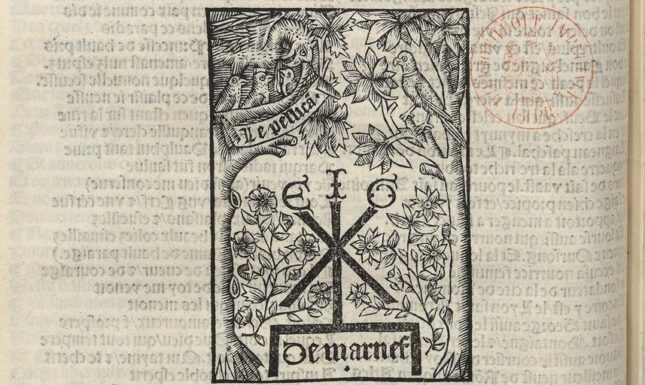
The Épistres de l’Amant vert by Jean Lemaire de Belges takes the role of parrots in the amorous affairs of humans to the next level, actively blurring the lines between the two species. In 1505, Lemaire was court poet to Margaret of Austria, who at this time was in deep mourning following the death of her husband, Philip of Savoy, but also of her favorite green parrot, who was eaten by a dog during her absence. Lemaire seized upon this event to write a light-hearted and consoling poem, in which he portrayed the parrot as Margaret’s Green Lover, simultaneously embodying both her late partner and pet [Fig. 3]. Heart-broken by his mistress’ decision to leave him behind, the ‘l’Amant vert’ willingly jumps into the jaws of the hound towards his death, leading to a Dantean journey through the underworld that eventually sees the parrot reach avian Paradiso.
See, hear, and speak nothing
Parrots do not solely imitate the acts of their human companions, but in certain works of literature also act independently, revealing intriguing connections between the ability to speak and the wisdom and wit of the speaker. For instance, the aforementioned Willeris is portrayed as a highly intelligent parrot, able to outsmart hunters with ease as he makes his way to Gauvain, while the parrot in Le Chevalier du papegau is repeatedly compared to the prophet Merlin for his ability to recall prophecies and predict the future – a mystical quality supposedly also attributed to some medieval parrots in real life.
To see the intelligence of parrots in practice, we can turn to a fabliau story embedded in the romance Le chevalier errant (1394-1396) by Thomas III of Saluzzo. In this tale, an elderly man is married to a young and beautiful lady. Suspicious of his wife, he places three parrots in a cage carefully positioned to monitor anyone entering or leaving the home. The man’s suspicions were quickly proven to be just, for as soon as he departs, his wife’s lover appears. Fearing what the parrots might tell her husband, the wife questions each parrot as to what they witnessed. The first two parrots speak the truth and are swiftly killed for their honesty. The third, wiser and older parrot, however, says he saw everything but is smart enough to see, hear and speak nothing and thus manages to escape with his life. As a result, in the home of an unloyal adulteress and ignorant cuckold it is a parrot who turns out to be the wised and most astute.
Multilingual masterminds
This specific tale is found in various sources ranging from India and Persia to Western and Eastern Europe, each tradition giving the story a unique spin. In the medieval Dutch tradition specifically, the intelligence of the parrots (and lack thereof) is given a multilingual dimension, further cementing the connection between wisdom and words.
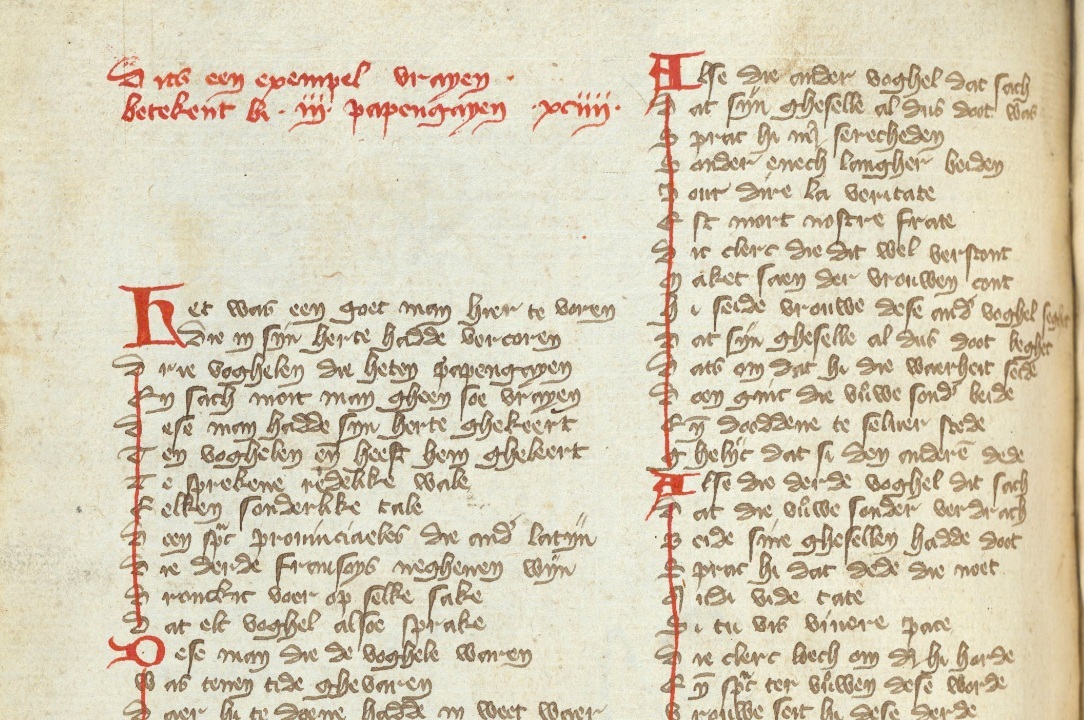
In the fabliau Dits een exempel vrayen betekent bi III papengayen, transmitted in the Van Hulthem manuscript (produced around 1405-1408 near Brussels), the three parrots each speak a different language: Central French, Occitan and Latin [Fig. 4]. When the first French parrot sees the wife and her lover kissing, he says: On fayt tort nostre singoer! (l. 28: They are harming our master!), and when the second parrot sees his brother be killed as a consequence, he shrieks: Pour dire la veritate, est mort nostre frate! (l. 43–44: For speaking the truth, our brother is dead!). The third parrot shares the same wisdom as his counterpart in the French text, but by stating this proverbial wisdom in Latin (ll. 57-58: Aude, vice, tace, sit u vis vevere pace) the intelligence of the message is emphasized through the authoritative status of Latin as a language of knowledge. Consequently, to the direct lesson of ‘know when to speak and when to remain silent’ one can now add a second lesson which holds that those who wish to speak wisely should speak Latin rather than the vernacular.
Flying high above these and all other multilingual parrots is the titular bird of the poetic satire Speke parrot (ca. 1521) by John Skelton. Written as an experimentation of poetic form, Skelton uses a polyglot parrot as a medium to formulate his own political views and criticism of contemporary social and institutional abuses. This parrot is a master of so many different languages that he can seamlessly codeswitch between them, almost as if unaware or dismissive of any perceived hierarchical differences between them. While this makes the text difficult for modern day readers, it simultaneously showcases the literary parrot as a figure who evolved from a human sidekick into a fully-fledged narrator whose linguistic and philosophical abilities serve as a reflection of the writers’ own skills.
Sources:
- Arnaut de Carcassés, La Nouvelle du perroquet, ed. Pierre Bec (Mussidan: Fédérop, 1988).
- Het handschrift-Van Hulthem, Hs. Brussel, Koninklijke Bibliotheek van België, 15.589-623, ed. Herman Brinkman & Janny Schenkel (Hilversum: Verloren, 1999).
- Jacob van Maerlant, Der naturen bloeme, ed. Eelco Verwijs (Groningen: J.B. Wolters, 1878).
- Jean Lemaire de Belges, Les épistres de l’amant vers, ed. Jean Frappier (Genève: Droz, 1948).
- Le Conte du Papegau, ed. Hélène Charpentier & Patricia Victorin (Paris: Champion, 2004).
- Thomas III of Saluzzo, Le chevalier errant, ed. Daniel Chaubert (Moncalieri: Centre d’Études Franco-Italiennes, 2001).
Further reading:
- Bernard Ribémont, ‘Histoires de perroquets: petit itinéraire zoologique et poétique’, Reinardus 3 (1990), 155–171.
- Bruce Thomas Boehrer, Parrot Culture: Our 2,500-Year-Long Fascination with the World's Most Talkative Bird (Philadelphia: University of Pennsylvania Press, 2004).
- Jane Griffiths, ‘Divers of Language: The ‘Macaronic’ Glossing of Skelton’s Speke Parrot’, in Multilingualism in Medieval Britain (c. 1066-1520), ed. Judith Jefferson & Ad Putter (Turnhout: Brepols, 2012), 211–224.
- Jelmar Hugen, ‘Vernacular Multilingualism. The Use of French in Medieval Dutch Literature’, Neophilologus 106 (2022), 181–198.
- Marilyn Lawrence, ‘Comic functions of the parrot as minstrel in Le Chevalier du Papegau’, in Comedy in Arthurian Literature, ed. Keith Busby & Roger Dalrymple (Cambridge: Brewer, 2003), 135–151.
- Meradith McMunn, ‘Parrots and poets in late medieval literature’, Anthrozoös 12 (1999), 68–75.
- Paul J. Smith, ‘De Groene Minnaar van Margaretha van Oostenrijk’, Virtus 29 (2022), 150–165.
- Remco Sleiderink, ‘Pykini’s parrot. Music at the court of Brabant’, in Musicology and Archival Research. Colloquium Proceedings, Brussels 22-23.4.1993, ed. Barbara Haggh, Frank Daelemans & André Vanrie. Special Issue of: Archief- en Bibliotheekwezen in België 46 (1994), 358–391.
© Jelmar Hugen and Leiden Medievalists Blog, 2026. Unauthorised use and/or duplication of this material without express and written permission from this site’s author and/or owner is strictly prohibited. Excerpts and links may be used, provided that full and clear credit is given to Jelmar Hugen and Leiden Medievalists Blog with appropriate and specific direction to the original content.