

Authority as a Connection: Medieval Scribes and Contemporary Academics
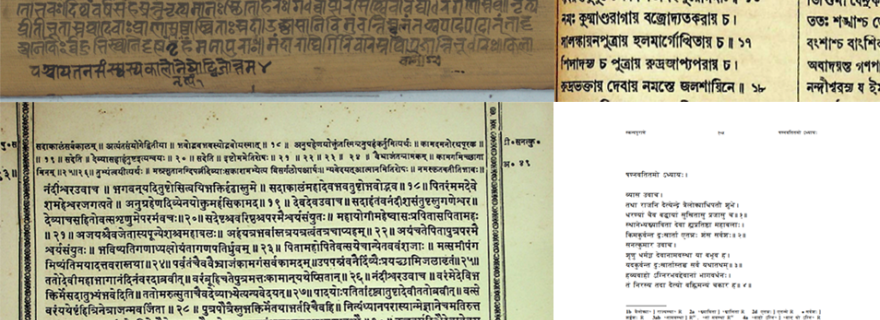
Manuscripts lie behind the academic study of any Sanskrit text. It may seem easy enough to just read a manuscript, note down what it says, and interpret it. However, studying manuscripts is more complex and authoritative decisions become necessary.
The Manuscript and its Alterations
Sanskrit manuscripts can contain many layers of scribal alterations, made by scribes and correctors at various points in time. Critical editions may then later be made in the scholarly pursuit of restoring these texts as close to their earlier forms as possible. The focus of my PhD research is a 12th–14th century CE palm-leaf manuscript, which is currently housed in the Kaiser Library in Kathmandu, Nepal. The manuscript contains a compendium of glorification texts called Mahatmya (“greatness,” “glorification”) which are focused on the sacred sites of the city of Varanasi in North India. We can see several indications of active use in this manuscript; namely, multiple layers of alterations, created over time by professional scribes, scribal students, correctors, or reciters.
More precisely, the manuscript, tentatively called Vārāṇasīmāhātmyasaṃgraha—“A Compendium of Mahatmyas about Varanasi”—contains three clearly separate layers of alteration. The first is of the several scribes who wrote the manuscript. They worked either by copying from an earlier version of the compendium, or by compiling it themselves directly from the various source texts. At least in part, their sources were illegible or were missing some characters, as the scribes have indicated gaps in the manuscript itself.
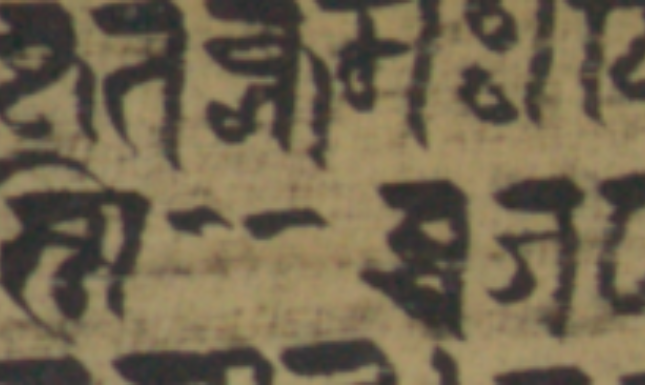

As evidenced twice by a change in handwriting, there were at least two, but most likely three different scribes who worked together on the production of the manuscript. However, a more precise identification of all the scribes involved is difficult to make due to often sloppy handwriting and the extensive smudging found on some of the palm-leaves.
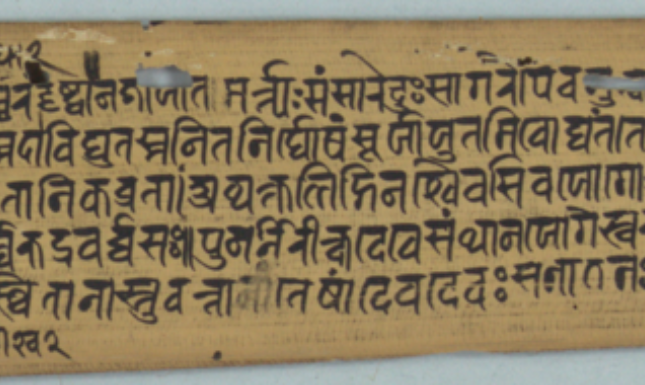
The second and third layers of alteration have been created by different correctors, who have altered the texts of the manuscript by correcting parts and adding passages in the margins. The main text of the manuscript is written in the Old Nāgarī script, whereas some of the corrections have been partially made in a different script, which is closer to a Nepālākṣara (i.e., Nepalese character) script. Some of the corrections are made by writing on top of the existing text, some between the lines, and some in the margins. Both the marginal additions and the additions added on top or in between the lines of text are made variously in the two aforementioned scripts. Occasionally, later correctors change earlier corrections or indicate deletions, adding even more complexity to the manuscript.
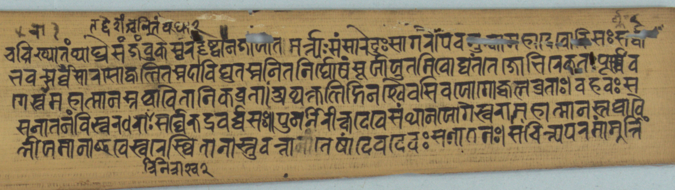
An additional layer of alteration is, perhaps surprisingly, not a part of the physical manuscript itself. Instead, this layer is created by the academic who edits the texts involved. The selection of textual variants that are considered the most “correct” is one part of the creation of an edition. Another involves emending the text when clear mistakes have been made, or, more ambitiously, making educated guesses in an attempt to fix parts which are deemed completely illegible or corrupt. But what is in fact correct? Is the perspective of contemporary academia or that of the correctors necessarily the most legitimate?
Authority and Studying the Manuscript
The correctors of the manuscript clearly had access to some, not all, of the source texts the compendium was created from, and these texts were used to restore parts of the manuscript’s texts. Some corrections were also made to correct grammar or restore the meters of verses, although with varying degrees of success. The correctors did not always work from the point of view of how we presently understand Sanskrit grammar. I do not mean that some of the alterations were always objectively wrong, but only that they simply might arise from a different understanding of what is correct in this context. When we—or the correctors—alter the text, do we in fact get rid of linguistic phenomena that are now seen as irregular, but may have been completely normal at the time of the creation of the texts in the manuscript, or add information that was originally not there? Both the correctors and the academic editors take up a position of authority whereby they feel empowered to make executive decisions regarding what is right and wrong.
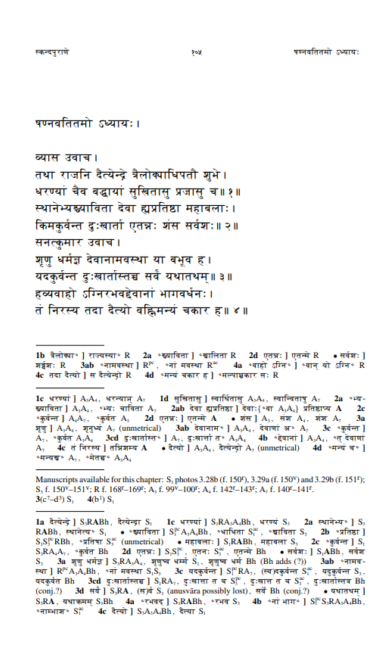
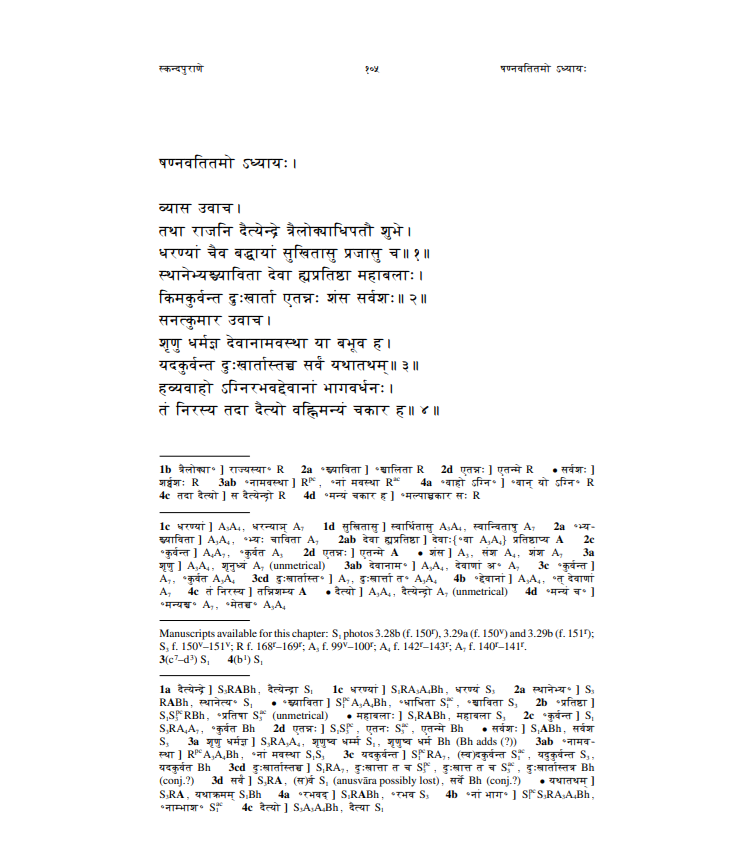
The further back in time we go, the less easy it is to keep track of these executive decisions. The contemporary layer of alterations created by academics working on the compendium is in fact the clearest in terms of seeing where these authoritative decisions come to play. Grammatical knowledge is based on the current understanding how Sanskrit should be written. However, even though some parts can be corrected as clear mistakes, others are harder to make sense of. The contemporary academic must then decide how to interfere with the text—or whether interfering is the right method at all, as sometimes it can be better to present the text as is instead of trying to fix it. Even so, academic conventions of editing provide one clear advantage: the critical apparatus, which is unfortunately often absent in editions of Sanskrit texts. The same can be said for noting which manuscripts were used in a given edition. The critical apparatus is a register accompanying the text, which records all the different variants of the text. In other words, in a critical edition text does not really get lost; all the different options can be found and reconstituted in the edition. However, there are choices to be made in the selection of readings, and this inevitably influences a reader’s perception of the text. Providing a bigger font and a more central position, for example, gives the reconstituted part of text a more authoritative air. Furthermore, the focus of a research project can influence what kind of text and presentation is needed. Are we making a comparison, a study of alterations, a corrected edition, or all of the above? In choosing an approach and preparing the text accordingly, the contemporary academic unavoidably exercises authority.
Authority and Motivations
For the original scribes, the reason for producing the manuscript that I am concerned with was most likely either the preservation of the texts of the compendium or producing another copy for someone’s use. The motivations of the correctors are perhaps obvious. They wanted to restore the contents of the manuscript to what they perceived were the grammatically and contextually correct forms of the texts. The academic who works on the manuscript mostly aims at something different, namely restoring the texts to the most likely original form or at least a form earlier than the one transmitted in the manuscript. In this addition, the contemporary academic also uses the texts for their own research, often involving matters of cultural-historical context. The motivation for doing research is one that the earlier users of the manuscript almost certainly did not have, and here, we can see a key difference in purpose regarding these two groups of people. However, the ability and willingness to intervene in a text from an authoritative point of view is shared by both groups, and although it may be subconscious, this kind of executive authority is an inevitable connection between contemporary academics and medieval scribes in South Asia.
Sources and further reading
- Bisschop, Peter C. 2021. The Vārāṇasīmāhātmya of the Bhairavaprādurbhāva: A 12th-Century Glorification of Vārāṇasī. Institut Franc̨ais De Pondichéry; École Française D'Extrême-Orient.
- Bisschop, Peter C. and Yuko Yokochi. 2021. The Skandapurāṇa Volume V. Adhyāyas 96–112. The Varāha Cycle and the Andhaka Cycle Continued. Brill.
- Littunen, Olli-Pekka A. 2024. “The Social Life of a Manuscript - Textual Networks from North India to Nepal and Beyond.” Textual Cultures: Texts, Contexts, Interpretation 17:2. Special Issue: Material Texts: Religion, Mobility, and Responsibility, 106-136.
- Śivapurāṇa (Bengali). Śivapurāṇam, Vol 1. Panchanan Tarkaratna. Jangamwadi Math Collection. 1908.
- Śivapurāṇa (Devanagari). Śrīśivamahāpurāṇa sanatkumārasamhitā ṭīkā sahita. Jangamwadi Math Collection. 1884.
- Mersch, Sanne. 2013. Travelling Through Time and Space with the Kapālamocanamāhātmya in the Vāyupurāṇa. MA diss., Leiden University.
© Olli Littunen and Leiden Medievalists Blog, 2026. Unauthorised use and/or duplication of this material without express and written permission from this site’s author and/or owner is strictly prohibited. Excerpts and links may be used, provided that full and clear credit is given to Olli Littunen and Leiden Medievalists Blog with appropriate and specific direction to the original content.